UBI: An Economic Imperative
Spring 2024
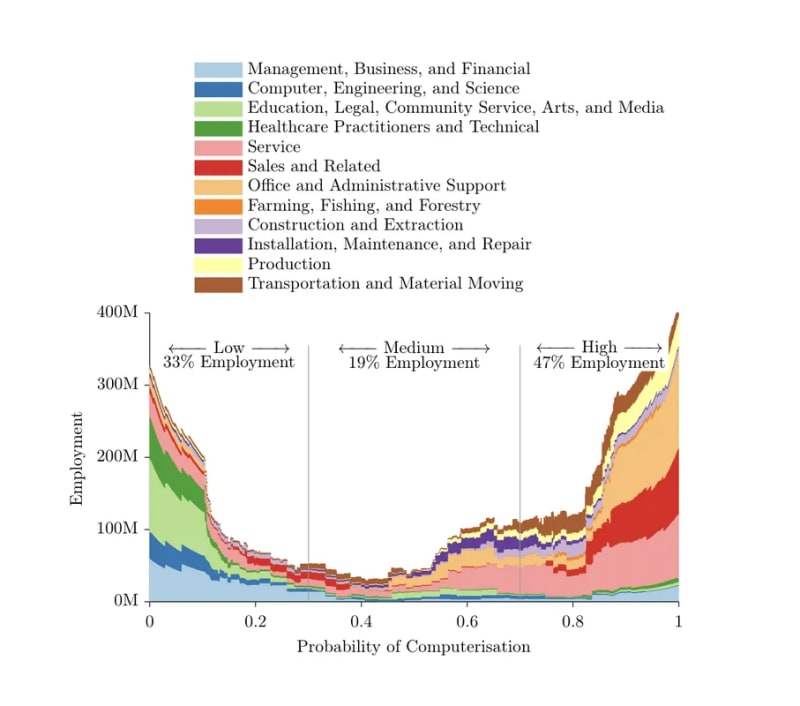
The rapid advancement of artificial intelligence and automation technologies is transforming the global economy at an unprecedented pace. As millions of jobs across diverse sectors become vulnerable to displacement, the specter of widening inequality and economic dislocation looms large. According to a seminal study by Carl Frey and Michael Osborne (2017) of Oxford's Martin School, an astonishing 47% of U.S. jobs are at high risk of automation by 2030, particularly those involving routine, predictable tasks in fields ranging from office administration and manufacturing to transportation and food services.
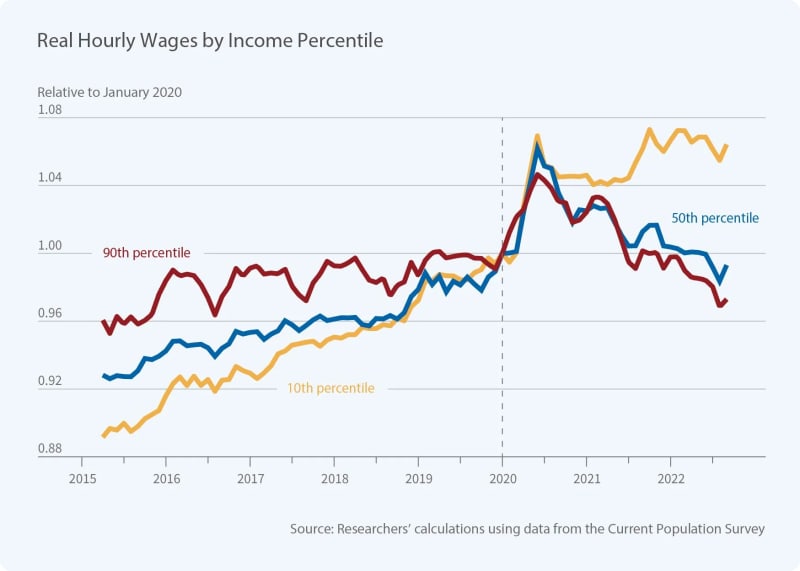
This seismic shift in the labor market threatens to exacerbate the already widening gulf between the highest and lowest income percentiles, trapping vast swaths of the workforce in a vicious cycle of stagnant wages and eroding job prospects. As routine labor across sectors is increasingly subsumed by machines, the bottom rungs of the workforce find themselves locked out of economic mobility and dignity. Unless proactive solutions are embraced to equitably distribute the productivity gains of the automation age, the livelihoods of tens of millions could be rendered economically redundant – a prospect fundamentally incompatible with the nation's core values.
Yet, in the crucible of this technological disruption lies a unique opportunity to reaffirm and revitalize our most cherished principles of economic justice by forging a new social contract. Just as visionary leaders of the past crafted groundbreaking reforms like Social Security and Medicare to meet the defining challenges of their eras, we must now summon the courage and foresight to implement a Universal Basic Income (UBI) as the bedrock of an updated social contract tailored to the realities of the accelerating automation age.
At its core, UBI enshrines the self-evident truth that access to a secure financial foundation to cover basic human needs is an inviolable right that should be decoupled from employment status in an era when jobs are increasingly automated out of existence. It proclaims that economic security is not a luxury but a necessity – both a fundamental human right and a patriotic fulfillment of the unalienable rights to life, liberty, and the pursuit of happiness. As the traditional link between labor and financial stability erodes, UBI serves as a vital bulwark against the erosion of economic liberty.
Beyond moral rectitude, the case for UBI rests on a compelling economic imperative. The same technological trends eliminating jobs also have the potential to unleash immense productivity gains and generate unprecedented wealth. The critical question is: who will benefit from these gains? Without a mechanism to broadly distribute the dividends of automation throughout society, we risk a doomsday scenario of soaring inequality and economic exclusion that could unravel our social fabric. UBI offers a powerful tool to harness the winds of technological change and channel them in a direction that expands opportunity and security for all.
Empirical research modeling the impacts of automation on different skill levels substantiates the risk of soaring inequality. A study by Brito and Curl at Rice University's Baker Institute predicts that as automation progresses, it will disproportionately depress the income shares of medium and low-skilled workers whose tasks are susceptible to automation. Their model, calibrated to 1980 U.S. economic data before significant automation, illustrates a stark redistribution of income shares. As more high-skilled labor is allocated to the most automated firms, their income share rises along with capital's share to the detriment of medium-skilled and low-skilled labor shares, which experience precipitous declines. This contrasts with the productivity gains driving the expansion of the high-skill and capital shares.

In the model's "Case 1" region, with increasing automation of routine tasks, the wage-setting power of medium and low-skill labor is effectively transferred to the lower marginal cost of robots performing those tasks. However, high-skill labor complemented by automation sees rising productivity and wages. The authors warn that without redistribution policies, this could result in exponentially increasing inequality as skilled wages and returns to capital soar while medium and low-skill wages stagnate or decline. By the hypothetical peak of "Case 2", with full medium-skill labor automation, the model projects the top 10% of skilled workers could capture over 3 times more income than the bottom 90% – an inequitable trajectory that risks undermining social cohesion and mobility if left unchecked.
Luduvice (2021) further illuminates how UBI presents a transformative approach to the welfare system that can address these persistent economic and social challenges. By eliminating the "threshold traps" induced by means-testing requirements in the existing system, UBI removes economic disincentives that distort individuals' work and income decisions. This can potentially increase labor supply and productivity, as individuals engage in work and entrepreneurial activities out of choice rather than necessity.
Moreover, UBI's universality ensures a stigma-free and equitable distribution of benefits. By providing the same basic income to every individual regardless of economic status, it simplifies administration and dramatically increases the take-up rate. This universality could significantly reduce administrative costs and barriers to access, making social support more accessible to all who need it.
While critics often cite the fiscal implications of UBI as a drawback, Luduvice's macroeconomic modeling demonstrates that even in scenarios where taxes increase to fund the program, the overall economic response includes redistributive effects that considerably benefit the lower income quintiles, more effectively addressing inequality than the current system. The model shows a redistribution of consumption from the wealthy towards the bottom quintiles, aligning with fundamental equity objectives.
Detractors argue that UBI will torpedo productivity, enable sloth, bankrupt the nation, and erode our cherished ethos of self-reliance. However, a sober accounting of the facts reveals the hollowness of these refrains. By streamlining our inefficient maze of overlapping welfare bureaucracies, closing gaping tax loopholes benefiting billionaires, and eliminating perverse subsidies to the very corporations automating jobs out of existence, we could liberate ample resources to fund UBI without adding to the deficit.
Furthermore, while UBI's presence may slightly adjust labor force participation, it also leads to higher savings and capital accumulation, which could support the economy. The enhanced agency individuals gain over their work-life choices, bolstered by the basic financial security UBI provides, may mitigate any initial negative impact on labor participation and contribute to long-term welfare improvements.
Ultimately, the notion that modestly taxing the immense windfall gains from automation to fund a wider distribution of economic security amounts to radical redistribution is sophistry. There is a compelling utilitarian case that such a policy is a matter of basic fairness and sound economic logic, not extreme ideology. Our true constraint is not material scarcity but an archaic scarcity mindset.
As we navigate the turbulent waters of the automation age, it becomes clear that a Universal Basic Income is not an unaffordable luxury but a moral and economic necessity. It is an urgently needed ethical breakthrough to salvage our founding ideals of economic liberty and self-determination against the tsunami of technological disruption. UBI enshrines the notion that access to a basic foundation of economic security and dignity should be a right of citizenship, not a privilege contingent on clinging to increasingly obsolete forms of labor. It serves as an essential safeguard against the specter of a stratified society permanently locked out of the productive economy by the robotic revolution.
Works Cited
- Brito, D., & Curl, R. (2020). Automation does not kill jobs. It increases inequality (Issue brief no. 11262020). Rice University's Baker Institute for Public Policy. https://doi.org/10.25613/g0pk-qt92
- Frey, C. B., & Osborne, M. A. (2017). The future of employment: How susceptible are jobs to computerisation? Technological Forecasting and Social Change, 114, 254–280. https://doi.org/10.1016/j.techfore.2016.08.019
- Luduvice, André Victor Doherty. 2021. “The Macroeconomic Effects of Universal Basic Income Programs.” Federal Reserve Bank of Cleveland, Working Paper No. 21-21. https://doi.org/10.26509/frbc-wp-202121.