Seagrams Building
Fall 2022
The Seagram Building stands as a landmark of mid-20th century modernist architecture that embodies many of the key tenets and innovations of the International Style pioneered by Mies. Its minimalist geometries, expressed structural frame, and pristine curtain wall set a new standard for the modern corporate office tower and had a profound influence on the subsequent development of high-rise architecture in the postwar decades.

Commissioned by the Canadian Seagram Company to serve as their New York headquarters, the 38-story tower features a sleek exterior characterized by its modular bronze mullions and tinted pink-gray glass. The tower's form is set back 90 feet from Park Avenue, an unprecedented gesture that opened up the dense urban fabric and created a generous plaza. Together, the tower's reductive prismatic mass and open plaza established a powerful urban presence that came to epitomize Mies' oft-cited aphorism "less is more" (Scott, 2011).
Several technical innovations distinguish the Seagram Building. The curtain wall's extruded bronze I-beams were specifically designed by Mies to give the façade a rich sense of depth, shadow, and visual texture lacking in the flat, planar curtain walls common at the time (Jordy, 1958). Other cutting-edge features included the tower's concrete core and cellular steel floor plates that maximized flexibility and the first use of high-strength bolted connections (Scott, 2011).
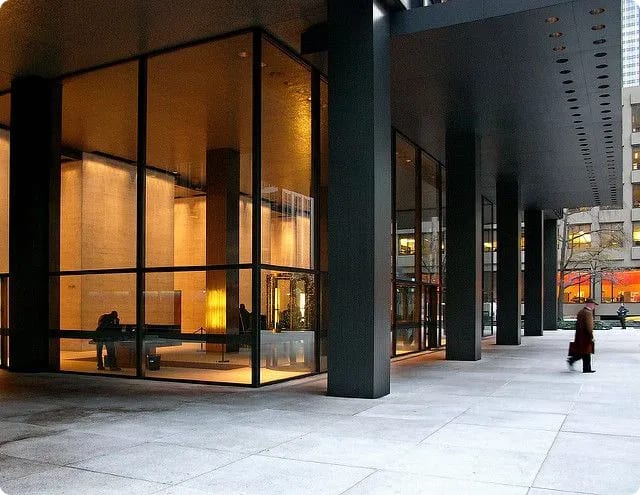
More than a feat of rational efficiency, however, Mies and Johnson conceived of the Seagram Building as a work of art. The tower's meticulous proportions, sumptuous materials, and bespoke detailing all attest to the architects' pursuit of an understated refinement and a "Baukunst" or building art. As Phyllis Lambert, the Seagram heiress who commissioned Mies, later reflected: "The person who had chosen the architect must stay with the job to fight for the concept" (Lambert, 1959). Under Lambert's vigilant patronage, the Seagram Building came to stand for the expressive potential of construction itself.
At the same time, the Seagram Building indexed broader transformations reshaping architectural production in the postwar period. As Arthur Drexler, curator of architecture at the Museum of Modern Art, recognized, the Seagram Building was intricately bound up with the globalizing networks of multinational corporations, the mass media, and consumer culture (Scott, 2011). In this regard, Seagram's pristine curtain wall and crisp plaza photography came to circulate as much as an image of prestige and power as any functional space.

Situated at the cusp between an older era of industrial production and an emerging postindustrial "information society," the Seagram Building crystallized the ambivalent potential of the curtain wall as both a material matrix and a media screen. If the tower's meticulously crafted bronze and glass facade resisted easy replication, its sleek, telegenic image lent itself all too readily to imitation in cities worldwide. Mies was said to lament of these numberless copycats: "We showed them what to do, why don't they do it?" (Drexler, 1979). Part of the building's enduring significance lies in illuminating this pivotal juncture between modernism's "art of building" and the spectacular image economies of postmodernity (Scott, 2011).
Works Cited
- Ingersoll, Richard. World Architecture: A Cross-Cultural History. Oxford University Press, 2020.
- Drexler, A. (1979, April 10). Transformations in Modern Architecture [Lecture transcript]. Museum of Modern Art Archives, New York, NY, United States.
- Jordy, W. H. (1958). Seagram assessed. Architectural Review, 124, 374-382.
- Lambert). How a building gets built. Vassar Alumni Magazine, 13-19.
- Scott, F. D. (2011). An army of soldiers or a meadow: The Seagram building and the "art of modern architecture." Journal of the Society of Architectural Historians, 70(3), 330-353.