The Sphinx
Fall 2022
The Great Sphinx of Giza, colossal in scale and perplexing in origin, stands as an enduring testament to the architectural genius and sculptural brilliance of Old Kingdom Egypt. Defying facile interpretation, this iconic monument has inspired scholarly debate and popular fascination for centuries. Marrying leonine body with human visage in harmonious synthesis, the Sphinx epitomizes the ancient Egyptian penchant for symbolic hybridization in its most monumental form. Yet the meaning and purpose behind its conception during the 4th Dynasty reign of Pharaoh Khafre remain elusive, shrouded in the same silence that envelops much of the Old Kingdom's religious thought and symbolic expression.
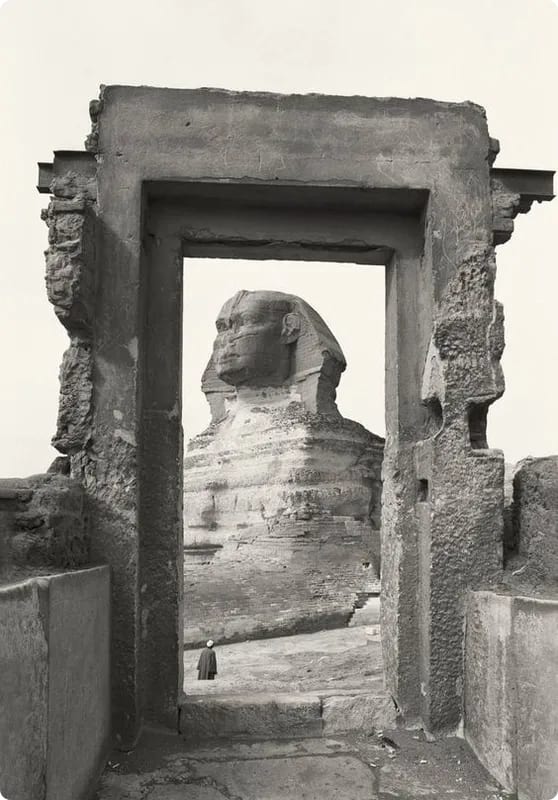
Hewn directly from the living rock of the Giza plateau, the Sphinx emerges organically from the geological strata that served as both source material and stabilizing plinth for the sculptors who gave it form. Its massive body stretches 240 feet in length and rises 66 feet from the bedrock, while the serenely regal human head, framed by the nemes headdress of kingship, stands 30 feet tall. This fusion of human and animal elements in a recumbent leonine form was a novel motif in the iconographic repertoire of the Old Kingdom, marking the Sphinx as a pioneering work in the history of Egyptian sculpture. Its location and orientation, aligned with the monumental funerary complex of Khafre yet standing slightly apart, bespeak a deliberate symbolic intent that remains opaque to modern interpreters.
The recent meticulous archaeological surveys conducted by Mark Lehner have revealed a complex history of erosion, degradation and successive phases of repair that the Sphinx has endured over the millennia. Subject to the inexorable forces of wind and weather, the heterogeneous geological composition of the body has resulted in uneven weathering across the statue's strata. Lehner's analysis identifies three major restoration campaigns spanning the New Kingdom through the Roman era, each employing distinct masonry techniques and materials to stabilize and encase the deteriorating stone core. The earliest phase, likely commissioned by Thutmose IV in the 18th Dynasty, entailed the application of substantial limestone blocks to rebuild the eroded lower body, creating a casing that would have presented a uniform finished appearance. Later interventions during the Late Period and under Roman rule focused on repairing this casing as it succumbed anew to the effects of erosion. These repeated attempts at preservation attest to the enduring significance invested in the Sphinx well beyond its original Old Kingdom context.

Indeed, the New Kingdom marked a pivotal era in the life history of the Sphinx, as the once-abandoned Giza plateau experienced a renaissance as a locus of royal patronage and popular devotion. Beginning with Amenhotep II and reaching an apogee under Thutmose IV, the temenos of the Sphinx became a focal point for royal self-representation and personal piety, centered on the worship of a new divine persona: Harmakhis, or "Horus-in-the-Horizon." This reinterpretation of the Sphinx as a solar deity, merged with aspects of Horus and fused with the Canaanite god Hauron, reflects the fluid theological imagination of the period. Royal stelae, votive objects, and sculptural additions transformed the Sphinx precinct into a veritable palimpsest of New Kingdom religious expression superimposed upon the Old Kingdom core.
The first millennium BCE witnessed further theological and iconographic elaboration at Giza as the cults of Isis and Osiris rose to prominence, establishing intricate ritual and toponymic linkages with the Sphinx. The Inventory Stele of the 26th Dynasty, despite its historically dubious attribution to Khufu, provides valuable insight into this phase, depicting a divine constellation in which Harmakhis, Isis, and Osiris preside jointly over the newly resurgent necropolis. Extensive restoration work on the Sphinx and its environs accompanied this religious efflorescence. Priestly families like that of Psamtik-sa-Neith left vivid traces of their devotion in the form of graffiti and statuary, illuminating an era in which the ancient origins of the site melded seamlessly with its living cultic vitality.
The arrival of Greek rule in Egypt under the Ptolemies marked yet another turning point in the long biography of the Sphinx. While the paucity of material evidence from this period suggests a potential lapse in cultic activity, the vibrant textual and archaeological record of the Roman era reveals a site imbued with new layers of cultural and religious meaning. Monumental reconfigurations of the Sphinx precinct, including the construction of an elaborate eastern entranceway and esplanade, parallel extensive masonry repairs to the statue itself. Greek and Latin inscriptions attest to an influx of foreign visitors who combined touristic wonder with theological speculation, equating Harmakhis variously with Horus, Helios, and other members of the syncretic pantheon. In poetic vignettes, these epigrams celebrate the Sphinx as an oracular guardian of cosmic order, awesome to behold yet beneficent in nature - a striking contrast to the malevolent Sphinx of Greek myth.

The modern historiography of the Sphinx, traced lucidly by Christiane Zivie-Coche, offers a revealing glimpse into evolving archaeological methodologies and interpretive frameworks. From the earliest speculative accounts of Medieval Arab chroniclers, rife with romance and fancy, to the sober yet fragmentary notes of pioneering excavators like Caviglia and Mariette, deciphering the Sphinx has proven an elusive enterprise. Technical advances, exemplified by Baraize's extensive photographic record and Lehner's meticulous surveys, have dispelled many misconceptions while raising new questions about the statue's original configuration and subsequent metamorphoses. Yet lacunae persist, and the paucity of direct textual evidence from the Old Kingdom itself leaves many facets of the Sphinx resistant to definitive explication.
In essence, the Great Sphinx of Giza endures as an enigmatic masterpiece, a Rorschach test in stone that has provoked myriad interpretations across cultures and eras while yielding its secrets sparingly. From its awe-inspiring fusion of human and leonine elements to its complex interweaving with the cults of Isis, Osiris, and other deities, the Sphinx embodies the protean nature of Egyptian religion and the fluidity of meaning that iconic monuments can accrue over time. While the impetus behind its 4th Dynasty origins remains unclear, its enduring power to inspire devotion, wonder, and endless speculation is a testament to the genius of its creators. Through meticulous archaeological and historical analysis, scholars can continue to unravel the many strands that comprise this monumental emblem of Egyptian civilization, even as its ultimate meaning remains tantalizingly out of reach. In confronting the silent majesty of the Sphinx, we are reminded of the limits of our knowledge and the inexhaustible capacity of great art to transcend its historical moment, provoking new responses with each generation that falls under its inscrutable gaze.
Works Cited
- Ingersoll, Richard. World Architecture: A Cross-Cultural History. Oxford University Press, 2020.
- Zivie-Coche, Christiane. Sphinx: History of a Monument. Translated by David Lorton, Cornell University Press, 2002.