Shivaji: The Architect of Swaraj and a People's Hero
Spring 2024
Shivaji Bhonsle, the founder of the Maratha Empire in 17th century India, stands as a polarizing figure in Indian history, revered and debated in equal measure. Celebrated for reviving Hindu political traditions in the face of foreign domination, he is also critiqued, labeled a mere regional bandit by opponents like Mughal Emperor Aurangzeb. However, a deeper analysis reveals Shivaji as a visionary leader who transcended simplistic labels, merging courage, compassion, and strategic governance to rejuvenate Hindu kingship. His reign introduced a legacy of emboldened resistance and model of effective rule, showcasing an impact that is both profound and nuanced, challenging the binary narratives of his historical persona.
Shivaji's rise to prominence occurred within a deeply divided Indian landscape, characterized by the vast Mughal Empire's dominance and punctuated by the presence of Deccan Sultanates. "By the time of Shivaji's birth, Jijabai's father and other male relatives had deserted the Nizam Shah in favor of alliance with the Mughal emperor Shah Jahan", highlighting the turbulent political environment and the decline of the Nizam Shahi dynasty that shaped his early years (Laine 5). His father, Shahji Bhonsle, served the Adil Shahi sultanate, placing Shivaji at the heart of the era's intricate political dynamics and battles for supremacy. Shivaji's ascent from his humble beginnings to the establishment of an independent Maratha kingdom is a testament to a deeper motivation: forging an independent sovereign state rooted in Hindu values.
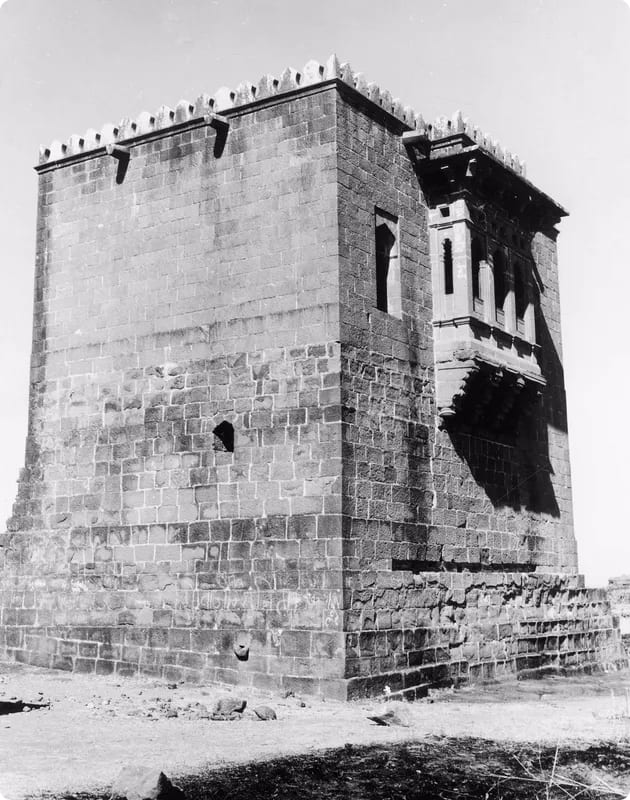
This driving influence, known as Swaraj, or self-rule, was deeply intertwined with Shivaji’s military and strategic endeavors, reflecting a holistic approach to sovereignty that was both ideological and pragmatic. His military tactics, particularly guerrilla warfare, were not merely strategies for survival but were emblematic of his broader vision to establish a realm that resonated with his Hindu values.
This strategic yet ideologically driven approach is found in the description of Shivaji's military engagements with foreign invaders: "Shivaji's strategy is to lure Afzal Khan to Javli, a place near the foot of Pratapgad, where they might conduct negotiations apart from their armies, with only a few bodyguards present. Shivaji's envoy emphasizes that Shivaji is in awe of the Khan, that he considers him his elder, an associate of his father, and that he was willing to submit to his wishes. This flatters the proud man, and he lets down his guard" (Laine 22). This passage highlights Shivaji's strategic acumen, where he cleverly manipulates the situation to his advantage, turning the tables on a superior military force.

The decision to engage in guerrilla warfare and Shivaji’s strategic use of the terrain were not just military decisions but also found great ideological synergy with his broader aspirations. By leveraging the natural defenses provided by the Western Ghats, Shivaji was not only protecting his sacred territory but was also preserving the cultural and religious ethos of his people against external influences. This approach was not only innovative but also contributed to the Maratha identity as resilient and tactful. His victories over formidable adversaries like Afzal Khan and Shaista Khan are celebrated tales of bravery that have become part of the cultural lore.
However, Swaraj was not merely a political or militaristic objective but also a cultural and religious aspiration that sought to establish an enduring governance model rooted in Hindu principles and autonomy from foreign influence. As such, Shivaji's strategic use of religious symbolism and his efforts to embody the values of a Hindu monarch were instrumental in articulating this vision of Swaraj. By aligning his rule with the protection and promotion of Hindu dharma, Shivaji endeavored to create a sovereign state that was not only independent in terms of political authority but also culturally and spiritually autonomous (Laine 38).
Laine emphasizes Shivaji's efforts to position himself as a protector of Hindu values, stating that contemporary tellings proclaimed "Shivaji a Kshatriya, the very status he needed to be crowned Chatrapati, an independent monarch" (Laine 24). This proclamation was not only a claim to a specific social and warrior class within the Hindu varna system but also a declaration of Shivaji's role as a guardian of Hindu dharma, encompassing the protection of gods, Brahmins, and cows, which are emblematic of the faith's moral and spiritual tenets.
Shivaji's coronation in 1674 was a seminal event that underscored his commitment to reviving Hindu kingship. The ceremony, described as an "orthodox lustration ceremony (abhiṣeka)," was a deliberate revival of royal Hindu traditions that had fallen out of use in Islamicate India (Laine 30). By reinstating these ancient rites and ceremonies, Shivaji not only legitimized his rule in the eyes of his subjects but also symbolically reclaimed Hindu sovereignty from Mughal dominance. This act of coronation was not an isolated event but part of a broader strategy to reassert Hindu cultural identity and Swaraj, as evidenced by Shivaji's engagement with prominent pundits to establish his genealogy and claim to true Kshatriya status, further reinforcing his legitimacy as a Hindu monarch (Laine 30).

Despite the clear alignment with Hindu values, Shivaji’s approach to administration is highlighted by his secular policies and respect for all religions. Laine notes that "Shivaji fought against Muslim powers to replace them with a Hindu state but a Hindu state governed by the modern secularist policy of religious tolerance" (Laine 85). In fact, Shivaji's secular governance also extended to his diplomatic engagements and alliances, which were not confined by religious affiliations. He skillfully navigated the complex political landscape of the 17th century, forming alliances with Muslim states when it suited his strategic interests, even as he fought against others.
This proved all a part of a pragmatic diplomatic approach to which Laine observed "there is no more clearly "Hindu" position than to exalt Akbar's policies and to patronize Muslim religious practices and persons within the context of Hindu culture. Such "tolerant" inclusivism is a fundamental structure of Hinduism" (Laine 39). Laine’s comparison to Akbar underscores Shivaji's vision of a sovereign state that transcended religious boundaries, aiming for a cohesive society under his rule. This aspect of Shivaji's governance, where he employed soldiers and administrators based on their merits rather than their caste or creed and respected the sanctity of mosques, tombs, and the Qur'an, showcases Shivaji’s legacy as not solely propelled by a devotion to Hindu dharma, but also through his embodiment of bravery and clever governance.
Emperor Aurangzeb's pejorative characterization of Shivaji as "a mountain rat" starkly contrasts with this reverence Shivaji commands as a symbol of resistance and the embodiment of a Marathi identity. This legacy is pronounced in the traditions of the Indian subcontinent, "for every year at the time of Dasara, a fall festival... children all over Maharashtra shape small mounds of mud into the hill forts of Shivaji and populate them with toy figures of Maratha warriors, their horses, and elephants" (Laine 4). This narrative, deeply ingrained in the traditions of Maharashtra, continues to inspire generations, reflecting his pivotal role in defying Mughal authority and fostering a distinct Hindu and regional consciousness.
Works Cited
- Laine, James W., Shivaji: Hindu King in Islamic India (New York, 2003; online edn, Oxford Academic, 3 Oct. 2011), https://doi.org/10.1093/acprof:oso/9780195141269.001.0001, accessed 19 Mar. 2024.