Colosseum
Fall 2022
The Flavian Amphitheatre, more commonly known as the Colosseum, stands as an awe-inspiring testament to the architectural brilliance and engineering prowess of the Imperial Roman Empire. Situated in the heart of Rome, this colossal structure epitomizes the grandeur and ambition of a civilization that left an indelible mark on human history. The Colosseum's construction is a marvel of ancient engineering, showcasing the Romans' mastery of materials science and their ability to push the boundaries of architectural design.

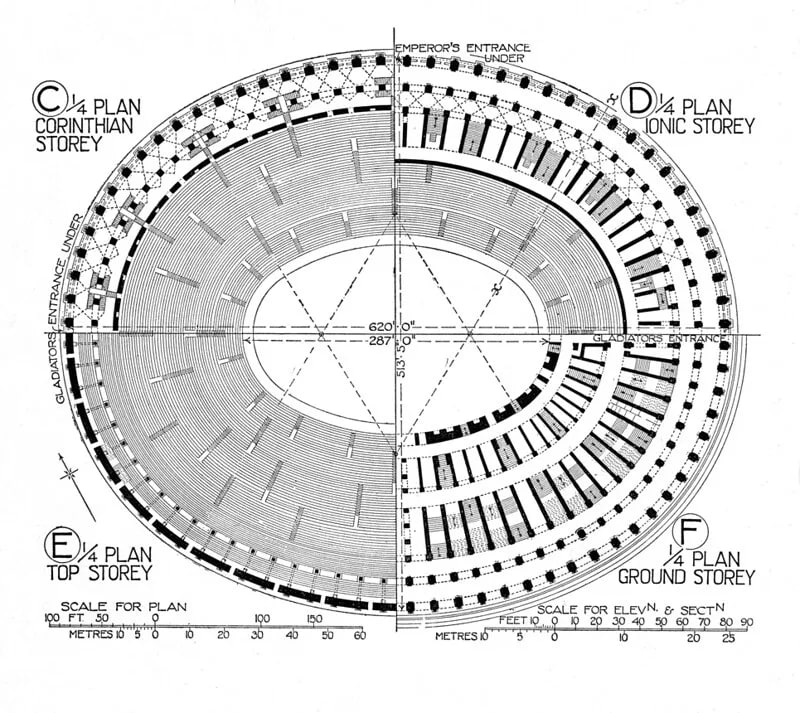
The Colosseum's design is a masterclass in the integration of form and function. The ingenious quadrarc plan, derived from a central rhombus, allowed for the creation of an elliptical structure that maximized seating capacity while ensuring excellent visibility for all spectators. This design, likely inspired by the simpler architecture of Roman theatres, involved dividing a circle into four parts by two diameters and arranging four shortened sectors, each designed as part of a theatre, into a cohesive whole.
The use of travertine stone, iron clamps, and the revolutionary opus caementicium (Roman concrete) in the Colosseum's construction demonstrates the Romans' deep understanding of the properties and potential of different materials. The invention of opus caementicium, made by mixing pozzolana (volcanic ash) with lime, was a game-changer in Roman architecture, enabling the creation of robust foundations and complex substructures that were previously impossible. The Colosseum's architects and engineers harnessed the power of this innovative material to create a structure that has endured for nearly two millennia, withstanding the tests of time, nature, and human activity.
The Colosseum's exterior façade, originally four stories high and adorned with Doric, Ionic, and Corinthian orders, drew inspiration from earlier Roman structures such as the Theatre of Marcellus, further emphasizing the connection between theatrical and amphitheatrical design. The use of 80 entrance arches, meticulously numbered and strategically placed, facilitated the efficient movement of spectators and participants, showcasing the Romans' keen understanding of logistics and crowd management.
Beyond its architectural wonder, the Colosseum served as a microcosm of Roman society, reflecting the complex social, political, and cultural dynamics of the empire. The amphitheatre was a venue for gladiatorial contests, animal hunts, and public spectacles that entertained the masses while simultaneously serving as a tool for political propaganda and social control. The seating arrangement strictly adhered to the Roman social hierarchy, with the emperor and the Vestal Virgins occupying the most privileged positions, followed by the senators, equestrians, and plebeians. This physical manifestation of social stratification reinforced the power structures that underpinned Roman society, reminding each spectator of their place within the imperial order.
The Colosseum's underground complex, the hypogeum, is a fascinating example of the Romans' ability to create multi-functional spaces that seamlessly integrated with the overall structure. This labyrinthine network of tunnels, chambers, and mechanical devices served as the backstage for the spectacles above, housing animals, gladiators, and stage sets that could be lifted into the arena using sophisticated pulley systems.

The Flavian Amphitheatre represents the culmination of centuries of Roman architectural experimentation and innovation, drawing upon the lessons learned from earlier theaters and amphitheatres while pushing the boundaries of scale, complexity, and symbolism. Its influence on subsequent Roman amphitheatres and its enduring legacy cannot be overstated. The Colosseum set the standard for future Roman amphitheatres, such as those built in Capua, Verona, and Pozzuoli, and its influence can still be seen in modern stadiums and entertainment venues.
Comparing the Colosseum to the monumental structures of other ancient civilizations, such as the Mesoamerican city of Teotihuacan, reveals fascinating parallels. These architectural marvels served as physical embodiments of the power, religion, and social structures that shaped their respective societies, reflecting the beliefs and values of the cultures that created them.
In conclusion, the Flavian Amphitheatre, or Colosseum, stands as a testament to the architectural brilliance, engineering skill, and cultural complexity of the Imperial Roman Empire. Its innovative quadrarc design, advanced construction techniques, and use of groundbreaking materials like opus caementicium demonstrate the Romans' ability to create structures that have endured for nearly two millennia. The Colosseum was not merely an architectural marvel but also a reflection of Roman society, serving as a venue for entertainment, political propaganda, and social control. Its legacy continues to inspire and influence architects, engineers, and artists to this day, cementing its status as one of the most iconic and significant structures in human history.
Works Cited
- Ingersoll, Richard. World Architecture: A Cross-Cultural History. Oxford University Press, 2020.
- Patton, L. R. (1998). The design of the Flavian Amphitheatre. Saint Mary's Digital Commons.