La Maison de Verre
Fall 2022
Constructed in Paris between 1928 and 1932, the Maison de Verre (House of Glass) designed by Pierre Chareau, Bernard Bijvoet, and Louis Dalbet does not fit easily within the canon of modern architecture and interior design. Though acknowledged at the time for its groundbreaking use of industrial materials and technological innovations, the house remained relatively obscure in architectural discourse until Kenneth Frampton's influential 1969 essay rescued it from critical neglect. Frampton provocatively asked whether the house should be regarded as a building in the conventional sense or as "a grossly enlarged piece of furniture, interject[ed] into an altogether larger realm?" (Frampton, 1969). This question, left unresolved by Frampton, suggests the house's greater significance may lie in its interior rather than its architecture. Can the Maison de Verre's importance be located in the quality of livability resulting from the sophisticated negotiation Chareau staged between the dictates of early modernism and the demands of habitation? This paper will argue that Chareau's design, as expressed in the house's interior, represents a valuable case study in domesticity that warrants greater consideration in the history and theory of interior design distinct from architectural history.

Analyzing the complexities of Chareau's design requires situating the house within the theoretical context and rhetoric of early modern architecture, especially the propositions of Adolf Loos and Le Corbusier that fundamentally challenged 19th century concepts of domesticity. Close examination of the house itself, based on both historical evidence and direct observation, reveals how Chareau negotiated between modernist ideology and the particular domestic needs of his clients. The collaborative design process involving Chareau, his clients, and craftsman Louis Dalbet facilitated many of the technological advances and attention to detail that placed livability at the center of the house's conception.
Among the most strident theorists of modern architecture, Adolf Loos and Le Corbusier virulently rejected the ornamented interiors of bourgeois society as antithetical to modern living. In his 1908 manifesto "Ornament and Crime," Loos (1970) categorically asserted "the evolution of culture is synonymous with the removal of ornament from utilitarian objects" (p. 20). Le Corbusier railed against the "conglomeration of useless and disparate objects" filling traditional homes, instead demanding bare walls, built-in storage, and an open plan (Le Corbusier, 1986). He famously declared that the modern house must be a "machine for living in" (p. 107). These polemics sought to overturn the 19th century domestic interior controlled almost exclusively by women, who focused on creating richly decorated, "livable" environments to conduct family life.
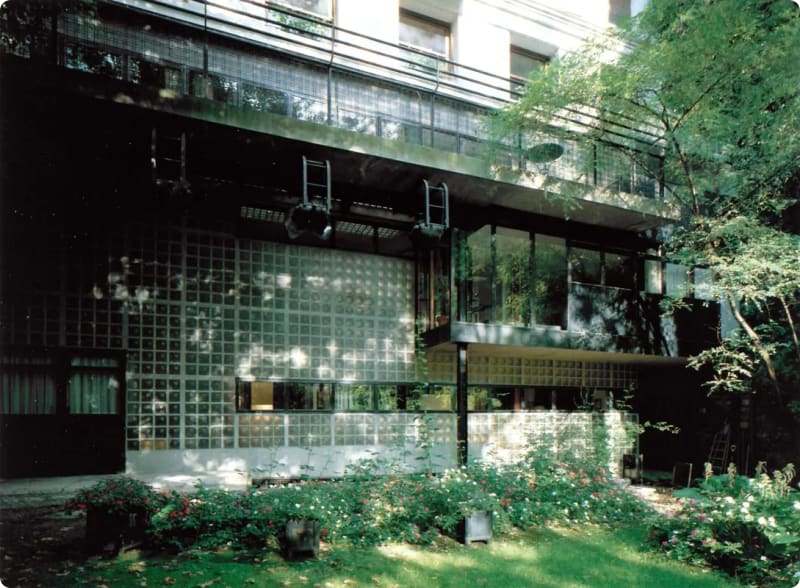
Chareau's involvement with early modernism positioned him to engage its evolving propositions. He regularly exhibited at Paris's progressive Salon d'Automne, helped found the modernist Union des Artistes Modernes, and served as an editorial board member of the avant-garde journal L'Architecture d'Aujourd'hui. Along with Le Corbusier, he was a signatory of the 1928 La Sarraz Declaration of the Congrès Internationale d'Architecture Moderne (CIAM) advocating for a rational, functionalist architecture.
Yet unlike Le Corbusier's heroic conception of the omnipotent male architect, Chareau preferred collaborating closely with clients. For the Maison de Verre commission, he found ideal patrons in Dr. Jean Dalsace and his wife Annie, committed modernists who introduced Chareau to Paris's cultural avant-garde. The couple wanted to insert a house containing both a medical clinic and a family residence into a challenging site - a narrow courtyard with an immovable top floor apartment. Working with Bijvoet and metalworker Dalbet, Chareau demolished the lower floors and employed a steel frame to support the existing structure above.

Rather than producing detailed plans, Chareau had Dalbet create full-scale mock-ups of interior elements, a technique enabling Mme Dalsace's integral involvement in the design process. Her role reflects the agency some modern female clients seized to shape new domestic environments responsive to unconventional ways of living (Friedman, 1998). The double-height salon served as a gathering space for the couple's avant-garde social circle, while Dr. Dalsace's ground floor medical practice served an innovative public health mission. This conflation of public and private realms within a single residence already distinguished the Maison de Verre's program.
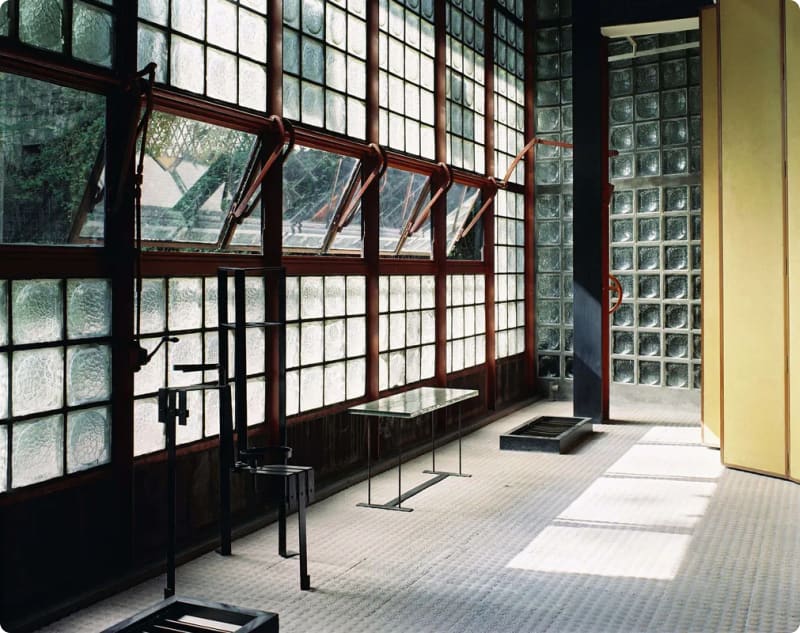
Examining the house through Kenneth Frampton's tripartite lens of "transparency, translucency, and luminosity" proves particularly revealing (Frampton, 1969). The street façade, composed of translucent glass block, breaks from both the opacity of the traditional Parisian townhouse and the transparent glass walls of high modernism. Penetrating the interior, this crystalline membrane transforms into a luminous machine animating the house's central volumes. In the soaring salon, the glass blocks cast an ethereal half-light akin to "the supremity felt in certain interiors of the cathedral and the palace" (Futagawa et al., 1988). At night, floodlights invert the diurnal effect, rendering the façade an enormous illuminated lantern.
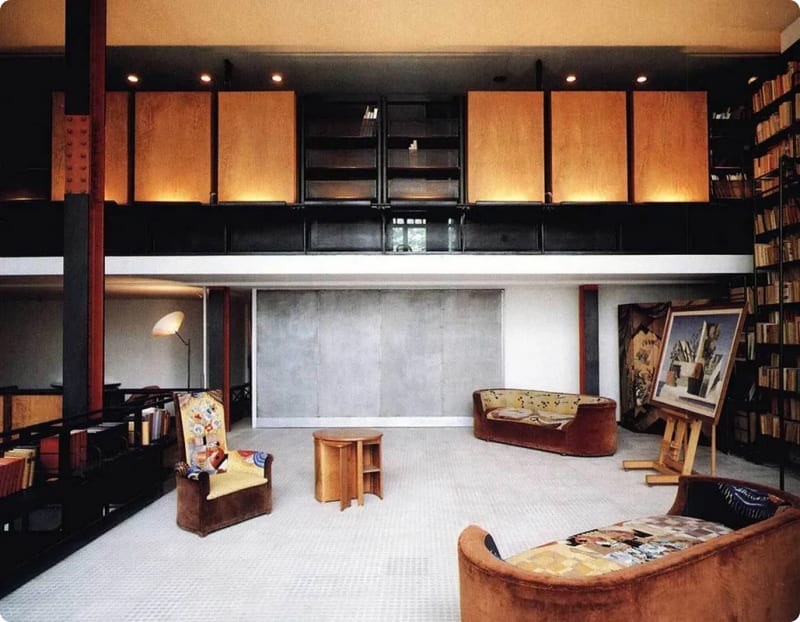
Yet for all this luminous theatricality, the Maison de Verre's overall impression is one of livability not immediately apparent in other canonical works of modernism. The Villa Savoye's inhabitants famously decamped after a decade of leaking roofs, while Edith Farnsworth found Mies's glass house unlivable due to lack of privacy. In contrast, the Dalsace family made the Maison de Verre their home for three generations. Chareau successfully resolved the house's various programs through ingenious planning. The medical suite's sequence of translucent partitions preserves patient confidentiality. Upstairs, sliding screens allow family members to calibrate degrees of privacy and intimacy. Mechanical innovations like the rotating shower column enhance functionality. Built-in cabinetry provides ample, highly specific storage. Surfaces invite sensory engagement, from the warmth of pearwood to the tactility of waxed steel.
These elements form a "poetry of technique" surpassing "any simple functional interpretation" (Frampton, 1969). Critics praised how the house "functions" and "works," marveling that "one does not suffer from either the heat or the cold" (Frampton, 1969). For one recent observer, inhabiting its intricately choreographed spaces evoked a "utopia of the senses" (Ouroussoff, 2007). This quality of livability, so central to the building's initial reception, speaks more to the "performance" of interior space in relation to human need than to a reductive functionalism (Wiederspahn, 2001).

The Maison de Verre demonstrates Chareau's ability to engage the dictates of early modernism while crafting an environment responsive to the particularities of his clients' lives. His design process, based on intimate collaboration and full-scale prototyping, facilitated technological innovations enhancing domestic experience. The house's sophisticated interplay of transparency, translucency, and luminosity works in service of highly specific programmatic needs. Chareau's attention to the material and spatial experience of the interior recalls Frampton's notion of the house as "grossly enlarged furniture." More than a stylistic exercise in "Machine Age Moderne" detailing, the Maison de Verre stages a compelling negotiation between avant-garde ideology and the embodied reality of habitation.

Evaluating the house through an interior design lens reveals Chareau's significant yet under-recognized contribution to modern domesticity. His achievement warrants greater prominence in the literature of interiors, where the Maison de Verre has been too often relegated to tertiary status behind better known examples of modernist architecture. Reclaiming the house's place in this discourse opens new avenues for analyzing how modern designers addressed the needs of real inhabitants. In an era when "the problem of the house [was] not posed," Chareau proposed one enduring solution (CIAM, 1970). The Maison de Verre reminds us that livability, too often subordinated in the heroic narratives of modern architecture, must remain the most vital charge of interior design.
Works Cited
- Ingersoll, Richard. World Architecture: A Cross-Cultural History. Oxford University Press, 2020.
- CIAM. (1970). La Sarraz Declaration. In U. Conrads (Ed.), Programs and manifestoes on 20th-century architecture (pp. 109-113). Cambridge, MA: MIT Press. (Original work published 1928)
- Forty, A. (2000). Words and buildings: A vocabulary of modern architecture. London: Thames & Hudson.
- Frampton, K. (1969). Maison de Verre. Perspecta, 12, 77-128.
- Friedman, A. T. (1998). Women and the making of the modern house: A social and architectural history. New York: Harry N. Abrams.
- Futagawa, Y., & Bauchet, B., Vellay, M. (1988). La Maison de Verre: Pierre Chareau. Tokyo: A.D.A. Edita.
- Le Corbusier. (1986). Towards a new architecture (F. Etchells, Trans.). New York: Dover. (Original work published 1923)
- Loos, A. (1970). Ornament and crime. In U. Conrads (Ed.), Programs and manifestoes on 20th-century architecture (pp. 19-24). Cambridge, MA: MIT Press. (Original work published 1908)
- Ouroussoff, N. (2007, August 26). The best house in Paris. The New York Times, pp. AR1, AR22-23.
- Vellay, M. (2007). La Maison de Verre: Pierre Chareau's modernist masterwork. London: Thames & Hudson.
- Wiederspahn). Mutable domestic space: The choreography of modern dwelling. In Proceedings of the ACSA International Conference: Occidental/Oriental, Geography, Identity, Space (pp. 265-269). Washington, DC: ACSA Press.