Literary Representation
Fall 2023
There exists a dialectical opposition between one’s identification with the fictional truth of a literary work and fictional literature’s innate superficiality. Words are objectively one-dimensional as a cultural tool and, without proper empathic connection and identification with a text and its characters, the overall epistemological influence is greatly diminished. However, developments within Modernism and contemporary cultural movements have begun to lift the obstacles in the way of a realized literary representation. Through analyzing novelist Gabriel García Márquez’s exemplar of magical realism, “Death Constant Beyond Love”, and the spiritual chaos of Franz Kafka’s “In the Penal Colony”, literature and literary characters can be seen as representing both an indisputable, conventional reality and a conceptual, ontological reality.

Gabriel Garcia Márquez established himself as an influential populist force within Hispanic literature during the 20th century and his 1970 short story “Death Constant Beyond Love” functions as a reflection of this political consciousness. Written in the style of “magical realism”, a literary tool where a realist narrative is intertwined with fantastic encounters, “Death Constant Beyond Love” follows the deceitful tale of Senator Onesimo Sanchez, a man with merely “six months and eleven days to live.” Despite his imminent death, Sanchez opts to run for re-election. He does so through a political Potemkin Village as seen in his public speeches’ use of “rented Indians who were carried into the town in order to enlarge the crowds at public ceremonies.'' Senator Sanchez is a mere caricature of a healthy, enduring political symbol and his fabricated hypocrisy is evermore revealing when applied to Márquez's geopolitical realm.
From the inception of this character, it’s evident that Márquez uses him as a symbol for the legitimate influence peddling and nefarious cronyism that plagues Latin American governments. Through the sickly facetiousness of Senator Sanchez, Márquez comments on the self-serving policies of these governments, and how they mercilessly continue their charade or “carnival” despite facing an inevitable collapse. In a discussion with his aides, Sanchez decrees that “the day there are trees and flowers in this heap of goat dung … neither you and I will have anything to do here.” A blatant denunciation of all civic duty, Sanchez implies that poorer conditions equates to heightened political fervor and chances of reelection.

Furthermore, Marquez is not just airing disdain for the rampant corruption, but also the ignorant masses who facilitate such moral bankruptcy. Through the character of Nelson Farina, a violent criminal who pawns off his daughter Laura to the Senator in exchange for illegal identification and becoming “beyond the reach of the law.” Despite the Senator being in a seemingly healthy marriage, Nelson uses the sexual temptation of his own daughter in order to simply keep living free. Nelson takes the form of the typical, apathetic citizen of which Márquez believes to only be feeding into this felonious feedback loop as supporters seem to achieve some semblance of a benefit from doing so. Then, despite his attempts at perverted escapism, “he would die in that same position, debased and repudiated because of the public scandal with Laura Farina and weeping with rage at dying without her.” Márquez demonstrates the idea that no illusion of prosperity or hedonistic bliss can pull a kleptocratic society away from imploding, and the current citizen hivemind only enables the political fraud that Latin America must endure.
Through the decisive character development within “Death Constant Beyond Love”, Gabriel Márquez is completely unambiguous in his symbolic parallels with contemporary Latin American politics. In fact, his “magical realism” not only moves the real into the fantastic, but it transcends an apparent regionalism in these metaphors into becoming a universal truth of mass ignorance and hierarchical strife. Thus, through the application of rhetorical certainty to supernatural happenings, Márquez and “Death Constant Before Love” serve as a model of how literature and literary characters may eclipse the pages of the book or a mere regional relevance to become a literary representation of reality’s absolute archetypal truths.

When a similar semiotic analysis is then directed towards more speculative and unconventional literature, it further reveals phenomenological specificities that otherwise escape superficial literary representation. In this way, Franz Kafka can be seen as completing the representational synthesis through his 1914 short story, “In the Penal Colony”; a fictional text that fuses existential absurdism with the unfettered tenets of literary surrealism. In the dystopian short story’s metaphysical exploration, Kafka uses his typical framework of cosmic misfortune and institutional injustice as he tells of an anonymous European explorer’s confrontation with a “peculiar apparatus” amidst an ambiguous tropical penal colony.

Any cursory critical analysis will predictably converge on the low hanging theocratic fruit posed by “In the Penal Colony” and the prophetic suffering and canonical allusions contained within. The once omniscient mysticism behind the peculiar machine’s “purification” of the colony’s prisoners and the fervently zealous officer, who is bound to the machine and the colony’s old Commandant by a filial connection, have begun to fall under the beckoning tides of change. The officer worships the old Commandant as a God, claiming he is a “soldier, judge, engineer, chemist [and a] draftsman,” yet a new Commandant is now at the helm. This new Commandant seeks to reform the overt lack of any proper legal procedure within the colony – a legal system that implies an innate guilt of all the condemned, similar to that of being born with sin. In fact, the legal system is merely a poorly masked Divine Lawl so “flawless” that the officer believes the new successor “would find … impossible to alter anything, at least for many years to come.”
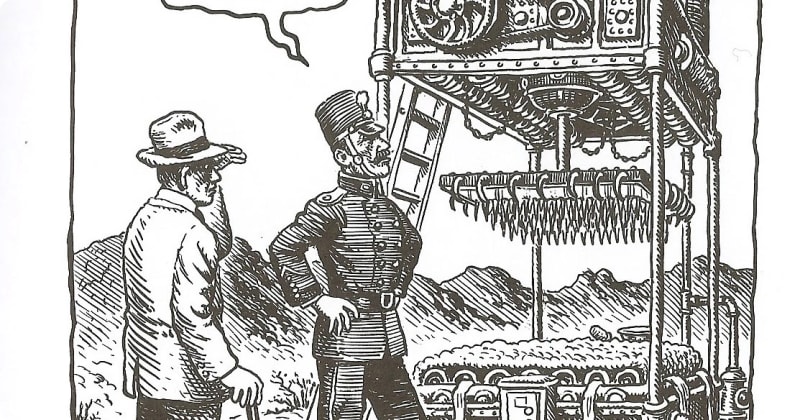
Nevertheless, such easily identifiable religious imagery does not yet offer a connection between the specific literary descriptions and a higher conceptual level. This phenomenological representation only comes when perceived in a contrasting manner. It’s only through a contemporary cultural lens that the officer is so easily condemnable for his sycophantic nature, but when the Explorer refuses to save the machine and determines the Officer’s lethal fate, is it not out of the Explorer’s own misplaced moral expectations? In the Officer’s final moments he was given the sentence to “BE JUST!”, but is justice not determined by one’s own cultural perceptions? In the exact manner that the officer’s justice disregarded the divide between myth over reality, the Explorer has dissolved the barrier between expectations and truth. Thus, Kafka’s prose and characters dictate a true ontological representation of reality through conceptualizing how one’s metaphysical form can never truly be separated from their material expression of said form.

“In The Penal Colony” accentuates the infinite phenomenological representation because it has taken an ineffective referential realism, which leads to such aforementioned religious conclusions, and it forces a careful observer to develop new perspectives and new hypotheses about the phenomena of existence. On the other hand, Gabriel Marquez’s “Death Constant Beyond Love” represents the alternate, absolute representation as it takes a mere local relevance and, through a tactfully obscure “magical realism”, applies it to the universal truths and generalized patterns of our reality. This is the core of literary representation where a rejection of Occam’s Razor and unconscious certainty in simplicity can lead to both universal conclusions or novel cognitive hypotheses about our existence.
Works Cited
- García Márquez, Gabriel. "Death Constant Beyond Love." In Collected Stories, translated by Gregory Rabassa, 155-164. New York: Harper Perennial, 1991.
- Kafka, Franz. "In the Penal Colony." In The Complete Stories, edited by Nahum N. Glatzer, translated by Willa and Edwin Muir, 140-167. New York: Schocken Books, 1971.