Laughing Through Tears
Spring 2024
The strategic use of tragic elements within comedies can be a powerful tool for deepening character development, sharpening social critiques, and enriching the audience's experience. Playwrights like Molière and Aristophanes skillfully integrate these elements by placing protagonists with tragic flaws at the center of their comedic narratives. In The Misanthrope, Alceste's uncompromising honesty becomes a comedic absurdity amidst a society rife with hypocrisy. Similarly, in Wasps, Lovecleon's obsessive attachment to jury duty fuels the play's humor. These tragic underpinnings, however, ultimately serve the comedic purpose. By subverting expectations and creating nuanced characters whose contradictions provoke both laughter and contemplation, the playwrights elevate the comedic experience. The tragic elements, though subordinate to the comedy, enrich it through richer character development, poignant social commentary, and a more emotionally resonant audience experience.
In The Misanthrope, Molière depicts the protagonist Alceste as a tragicomic hero, a man whose uncompromising honesty becomes a tragic flaw within the hypocritical high society he navigates. Alceste's convictions about truth and integrity recurrently clash with the norms of superficial politeness, as seen in his diatribe against “these lavishers of meaningless embraces" to his friend Philinte: “All men are so detestable in my eyes, I should be sorry if they thought me wise” (Molière 11).
While Philinte represents accepted social lubricants of deceit, Alceste vehemently rejects such hypocrisy. His steadfast idealism, though admirable, tragically isolates him in a world he cannot accept. Alceste's refusal to moderate his integrity renders him comically out-of-step, inviting audiences to laugh at his impractical plights even as they may admire his commitment to honesty.
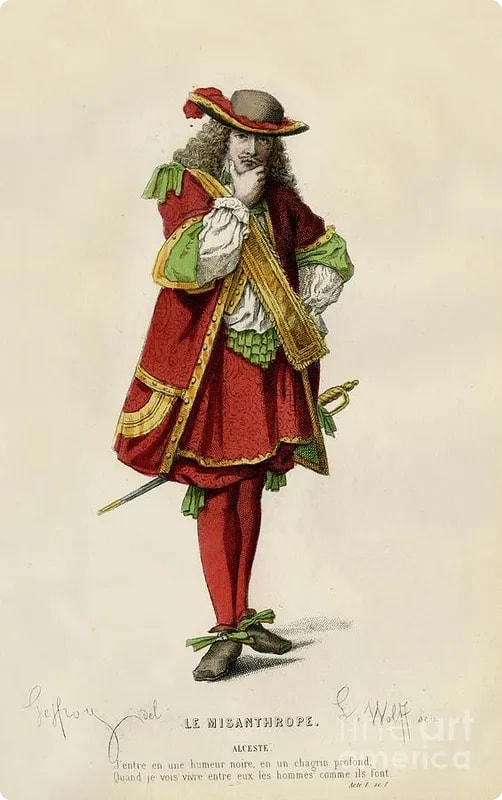
This tragicomic tension extends to Alceste's legal troubles and romantic pursuits. His quest for justice in a corrupt system and his love for the coquettish Célimène, despite disdaining her insincerity, deepen his alienation yet provide rich satirical humor. Alceste's efforts to uphold principles only amplify his frustrations in such comedic ways. For instance, when confronting Célimène about her flirtatious ways, Alceste rages:
I mean that sins which cause the blood to freeze
Look innocent beside your treacheries;
That nothing Hell's or Heaven's wrath could do
Ever produced so bad a thing as you. (Molière 62).
By grounding the comedy in Alceste's tragic idealism constantly clashing with social reality, Molière creates a memorable protagonist whose nuanced flaws and plights enhance the critique of societal hypocrisy. The tension between Alceste's convictions and his farcical struggles lends gravitas to the play's satirizing of superficial civility.
In Aristophanes’ Wasps, the character Lovecleon's tragic obsession with participating in jury duty serves as a similar focal point for comedic exploration and societal critique. This obsession, while tragic in its compulsive nature, becomes a source of humor through the play's exaggerated depiction of Lovecleon's condition. His son Loathecleon goes to great lengths to “cure” him, creating scenarios that are both ludicrous and insightful, such as the mock trial for their household dogs over a stolen cheese:
LOATHECLEON. Now all hear the charge…
against Snatches of Aexone,
for criminally devouring a Sicilian cheese...
The proposed penalty: a collar of impeach-wood. /
LOVECLEON. No, he'll get death, a dog's death, if he takes this fall!
(Aristophanes 232, lines 894-898)
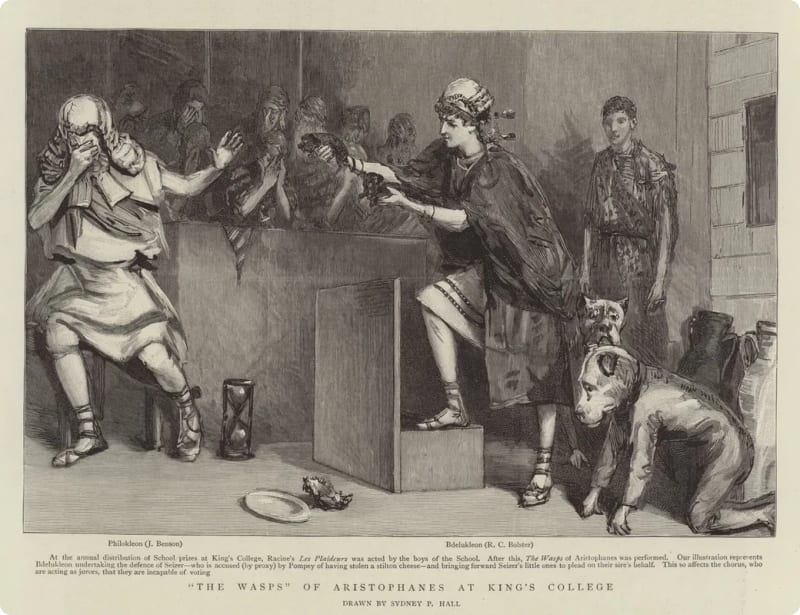
Despite the comedic absurdity, the scene reveals Lovecleon's desperate need for the power and relevance jury service provides, so much so that he replicates the courtroom with animals as defendants. This highlights his inability to find purpose outside the judicial system, suggesting an emptiness filled only by his obsession. The mock trial thus deepens our understanding of Lovecleon's tragic condition of compulsions so intense they leave him unable to meaningfully connect with the world.
Simultaneously, the mock trial satirizes the Athenian legal system. By reducing the court's proceedings to a farce involving dogs and petty crimes, Aristophanes critiques the litigious nature of Athenian society and the perceived frivolity of many legal disputes. The scene suggests that the courts, which should be pillars of justice and order, can be as irrational and arbitrary as a trial over a stolen piece of cheese by a dog. This mockery is compounded by the fact that Lovecleon treats the trial with utmost seriousness, underscoring the absurdity of both his character's obsession and the legal system itself. The trial, therefore, becomes a vehicle for Aristophanes to comment on the flaws and excesses of Athenian democracy and its legal institutions.
While tragic undertones serve this satirical purpose, they also allow comedic characters greater dimension in otherwise commonly rigid roles. In the case of Alceste, this introduced depth embodies the tensions between individual integrity and societal hypocrisy. Alceste’s intensity is revealed in Act 5, Scene 1 where he declares his disillusionment with the duplicity of society and his intention to isolate himself from it. He concedes:
Come then: man's villainy is too much to bear;
Let's leave this jungle and this jackal's lair.
Yes! treacherous and savage race of men,
You shall not look upon my face again (Moliére 70).
This quote highlights the tragic heroism of Alceste as his refusal to compromise his moral integrity leads him to a self-imposed exile, a decision that reflects his profound disillusionment with society's hypocrisy. Unlike typical comedic characters who might find themselves in humorous predicaments due to their stubbornness, Alceste's steadfastness results in personal isolation, a decidedly tragic outcome. His commitment to honesty and virtue in a world that does not value these traits isolates him from others, leaving the audience to reflect on the paradoxes of human behavior and the cost of one's own moral determination.
Aristophanes employs a similar tragic underpinnings into the comedic commentary of Wasps. Here, Lovecleon's overwhelming obsession with jury duty emerges as a powerful embodiment of tragic flaws - an all-consuming fixation that governs his identity. This depiction taps into the play's wider satirical commentary on the excesses of Athenian democracy and citizenry's unhealthy entanglement with the legal system. However, Aristophanes deftly interweaves tragic and comedic elements by subjecting Lovecleon's tragic flaw to an arc of attempted rehabilitation through his son's comedic interventions.
Yet, the chorus raises doubt whether Lovecleon's shift towards a life of leisure represents authentic, lasting change, suggesting “it's hard for anyone to depart from his normal and natural character” (Aristophanes 249, lines 1456-1457). This portends a fundamentally tragic dimension to Lovecleon as someone so defined by his obsession that true transformation may be impossible, despite any comedic misgivings. His struggle between embracing a new lifestyle and reverting to old litigious habits emblematizes humanity's shared challenges with change and self-perpetuating fixations.
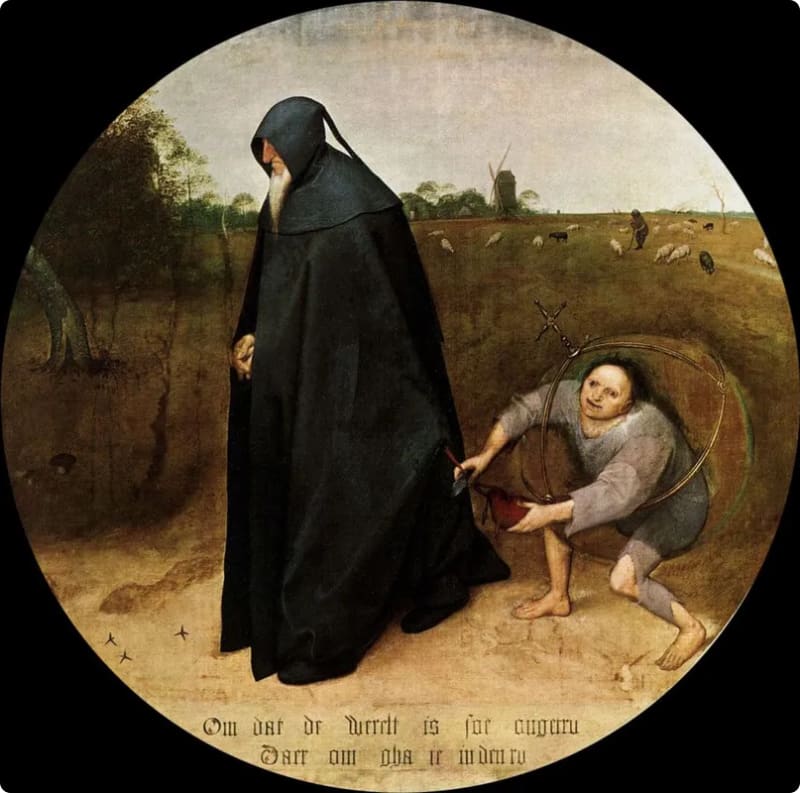
The parallel between the characters of Lovecleon and Alceste is nuanced by the open-ended conclusion of The Misanthrope. While Alceste shares Lovecleon's tragic idealism and stubbornness, the resolution of his story diverges significantly due to the play's lack of a neatly tied conclusion. In the climactic moments, Alceste faces a decision that could compromise his principles for the sake of Célimène, yet the play concludes without a clear resolution to his inner conflict. This open ending emphasizes Alceste's struggle between his ideals and the societal norms he despises. Unlike a comedic resolution that might require Alceste to bend his principles, the play leaves his fate ambiguous, underscoring the tragic dimension of his unwavering idealism. This unresolved ending serves as both a comedic defiance of neat conclusions and a tragic reflection on the impossibility of fully transcending society's imperfections.
The use of tragic elements within comedic works, as exemplified by Molière's The Misanthrope and Aristophanes' Wasps, serves to deepen character complexity, facilitate social critique, and produce a more emotionally resonant experience for audiences. By depicting protagonists consumed by tragic fixations and uncompromising idealism, these playwrights inject an underlying gravitas that amplifies the comedic impact while inviting contemplation of profound human contradictions. The tragic dimensions of Alceste's brutal honesty and Lovecleon's obsession with jury duty transcend mere comic devices, becoming powerful vehicles to satirize societal hypocrisy, corruption, and obsessive human folly. Crucially, the tragicomic elements are carefully subordinated to the comedic purposes - subverting expectations, but resolving in a way that reaffirms the superiority of moderation over inflexible principles. This integration lends depth and poignancy, producing an enriching synthesis where laughter contains the kernel of sobering self-reflection on the complexities of the human condition.
Works Cited
- Henderson, J. (2022). Three More Plays by Aristophanes: Staging Politics (1st ed.). Routledge. https://doi.org/10.4324/9781003159407
- Molière, and Richard Wilbur. The Misanthrope And Tartuffe. Mariner Books, 1993. EBSCOhost, search.ebscohost.com/login.aspx?direct=true&db=nlebk&AN=1871803&site=ehost-live&scope=site.