The Hiroshima Peace Memorial
Fall 2022
Kenzo Tange's Hiroshima Peace Memorial Park stands as a powerful symbol of postwar Japan's rebirth and its quest to redefine a modern national identity in the aftermath of the war's devastation (Cho, 2012). Completed in 1955, the park complex emerged from the ravaged site of the atomic bomb's epicenter to become an enduring monument to peace and a catalyst for a new direction in Japanese architecture. Through its dynamic fusion of international modernist principles with a reinterpretation of Japanese cultural traditions, Tange's design encapsulated the complex sociopolitical and intellectual currents that shaped Japan in the early postwar era.
The origins of the Hiroshima Peace Memorial Park can be traced back to 1946, when Tange, then a young professor at the University of Tokyo, volunteered to work on the war-torn city's reconstruction at the request of the War Damage Rehabilitation Board . Confronted with a tabula rasa, Tange envisioned a radical reimagining of Hiroshima's urban fabric centered around a large-scale park complex near the bomb's hypocenter. This utopian plan, which was partially incorporated into the official 1947 reconstruction scheme, reflected Tange's ambition to establish a legitimate architectural language for the postwar era, distinct from the nationalistic and imperialist overtones that had tainted his celebrated wartime projects (Cho, 2012).
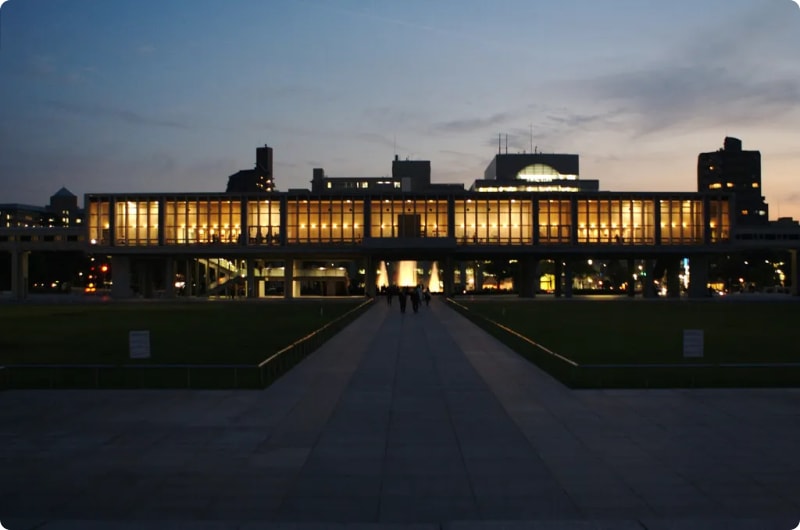
Tange's prizewinning proposal for the 1949 design competition of the Hiroshima Peace Memorial Park embodied the triumphant resurgence of international modernism in immediate postwar Japan . Its composition, defined by an axial layout and austere reinforced concrete structures raised on pilotis, drew heavily from the rationalist vocabulary of Le Corbusier and the Brutalist aesthetic then in vogue in Europe. Notably absent were the explicit references to Japanese architectural tradition that had characterized Tange's propaganda-laden designs from the war years, such as the Greater East Asia Co-Prosperity Sphere Memorial Building (1942) (Cho, 2012). This stylistic shift aligned with the prevailing belief among Japanese architects that traditional elements were indelibly linked to the discredited wartime regime and incompatible with the democratic ideals of the postwar world (Wendelken, 2002).
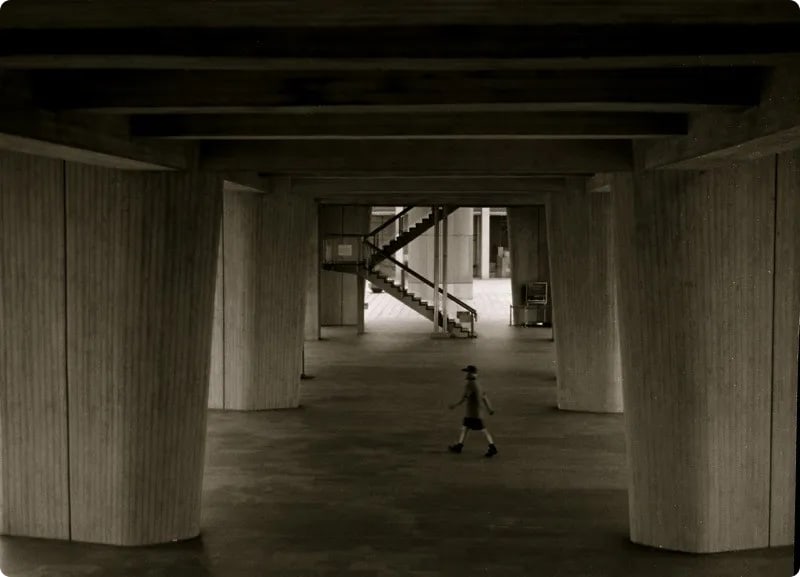
The Peace Memorial Park's centerpiece, the Memorial Complex comprising the Exhibition Hall, Main Hall, and International Conference Center, functioned as a monumental gateway that framed visitors' experience of the symbolic journey from present to past . Its imposing piloti-raised forms enclosed and dwarfed the skeletal remains of the Atomic Bomb Dome, transforming this visceral reminder of the nuclear holocaust into a poignant yet unthreatening relic. This spatial composition reflected the future-oriented ideology that undergirded the park's conception as a "factory for peace" actively working to transcend the traumas of the past. Sanctioned by both the Allied occupation authorities and the Japanese government, this emphasis on world peace allowed a collective amnesia about the nation's imperial legacy and the root causes of Hiroshima's tragedy (Cho, 2012; Yoneyama, 1999).
As the Hiroshima project progressed over the following years amidst the shifting intellectual climate of the post-occupation period, Tange gradually began to move away from a wholesale embrace of international modernism and reincorporate allusions to Japanese culture in his work . A pivotal influence was his 1951 encounter with Japanese-American sculptor Isamu Noguchi, who encouraged a reevaluation of tradition through a modernist lens untainted by wartime nationalism . Although Noguchi's proposal for a cenotaph derived from ancient Japanese artifacts was ultimately rejected, it catalyzed Tange's renewed interest in situating his architecture within a native lineage (Cho, 2012).

This "turn to tradition" found its most iconic expression in Tange's identification of the Hiroshima Peace Memorial Park as a new "prototype" for Japanese modernism analogous to the sacred Shinto shrine complex at Ise . To circumvent Ise's problematic associations with imperial authority, Tange and his collaborator, architectural critic Noboru Kawazoe, constructed an alternative genealogy that traced its origins to the prehistoric Jōmon and Yayoi civilizations (Cho, 2012). In their ambitious 1962 publication Ise: The Prototype of Japanese Architecture, Tange and Kawazoe argued that Ise's spaces synthesized the vital and primal energy of the Jōmon with the refined elegance of the Yayoi—a "creative tension" they saw embodied in Hiroshima's juxtaposition of raw concrete surfaces and pristine geometric forms (Tange et al., 1962).
Tange further linked this Jōmon-Yayoi dialectic to a broader sociopolitical discourse on the role of "the people" (minzoku or shimin) in Japan's postwar democracy. Just as Jōmon culture represented a potent life force springing from the masses, Tange envisioned the Peace Memorial Park as a lively public agora where citizens could gather and interact, thereby fostering the social cohesion essential to the nation's democratic rebirth. Critics like Kawazoe, however, astutely recognized that this invocation of "the people" as a new collective subject risked echoing the rhetoric used to mobilize the populace for imperial expansion only a few years prior (Cho, 2012).
The Hiroshima Peace Memorial Park's legacy extends far beyond its manifestation of postwar debates on modernism and tradition in Japanese architecture. As a monumental space that sought to reframe the nation's wartime history in universalist terms, it presaged Tange's later projects such as the 1964 Tokyo Olympics facilities and the 1970 Osaka Expo, which similarly deployed a language of world peace and progress to rehabilitate Japan's global image. The strategies Tange pioneered for synchronizing native culture with contemporary international currents would profoundly shape the subsequent Metabolist movement of the 1960s. Mentored by Tange, Metabolist architects and theorists further developed his nuanced approach towards tradition, drawing on concepts of transience and renewal from Buddhism and vernacular architecture to inform their futurist urban visions (Cho, 2012).

Embodying a critical juncture in Japan's postwar negotiations between past and future, nationalism and internationalism, Tange's Hiroshima Peace Memorial Park transcended its commemorative function to become a global touchstone for architecture's capacity to express evolving cultural identities. Its influence reverberates in the work of later generations of Japanese architects like Arata Isozaki, who refined Tange's insights on Japan-ness into new spatial paradigms responsive to the nation's economic resurgence. Seen from a transnational perspective, the Peace Memorial Park stands as a prototypical example of what architectural historian Rem Koolhaas has termed "a post-Western aesthetic"—an emergent sensibility that challenged modernism's claims to universality by asserting the vitality of non-Western building traditions (Koolhaas & Obrist, 2011). In its eloquent mediation of the competing imperatives and ruptures that defined the postwar moment, Tange's monument to Japan's past and aspirations for the future endures as a landmark in the nation's turbulent quest for a modern identity (Cho, 2012).
Works Cited
- Ingersoll, Richard. World Architecture: A Cross-Cultural History. Oxford University Press, 2020.
- Cho, H. (2012). Hiroshima peace memorial park and the making of Japanese postwar architecture. Journal of Architectural Education, 66(1), 72-83.
- Koolhaas, R., & Obrist, H. U. (2011). Project Japan: Metabolism talks. Taschen.
- Tange, K., Kawazoe, N., & Watanabe, Y. (1962). Ise: Nihon kenchiku no genkei [Ise: Prototype of Japanese architecture]. Asahi Shinbun.
- Wendelken, C. (2002). Aesthetics and reconstruction: Japanese architectural culture in the 1950s. In C. Hein & J. M. Diefendorf (Eds.), Rebuilding urban Japan after 1945 (pp. 183-197). Palgrave Macmillan.
- Yoneyama, L. (1999). Hiroshima traces: Time, space, and the dialectics of memory. University of California Press.