Oppression to Partition: Kashmir's Conflicted Past
Spring 2024
The partition of British India in 1947 presented the princely state of Jammu and Kashmir with a critical choice: accede to India or Pakistan. The state's Hindu ruler, Maharaja Hari Singh, governed a predominantly Muslim population, a demographic reality that, coupled with the Maharaja's indecision and an invasion by tribal militias from Pakistan in October 1947, precipitated a crisis. The Maharaja's controversial decision to sign the Instrument of Accession, joining India in exchange for urgent military assistance, and the subsequent escalation into the First Indo-Pakistani War, are often marked as the "beginning" of the enduring geopolitical tensions in the region. However, this characterization is reductionist, as the roots of the conflict extend far beyond the Instrument of Accession, deep into Kashmir's tumultuous recent history. The oppressive policies of the Sikh Empire and Dogra Dynasty against Muslims, reinforced by British indirect rule, had fostered an environment rife with socio-political grievances and competing ethno-nationalist and religious identities, setting the stage for the upheaval that accompanied partition.
Kashmir's political trajectory took a pivotal turn in the early 19th century with the ascendancy of the Sikh Empire under Maharaja Ranjit Singh. Ranjit Singh's conquest of Kashmir in 1819, wresting control from the oppressive Afghan Durrani Dynasty, marked the beginning of a Sikh rule characterized by "consistently follow[ing] anti-Muslim policies in Kashmir, thus subjecting the majority of the population of the Kashmir Valley to severe hardship in relation to the practice of their religion" (Zutshi 53). The state's reclamation of lands associated with various shrines, designation of mosques as state property, and prohibition on Muslims performing the call to prayer in mosques across the Valley exemplified this discriminatory approach.
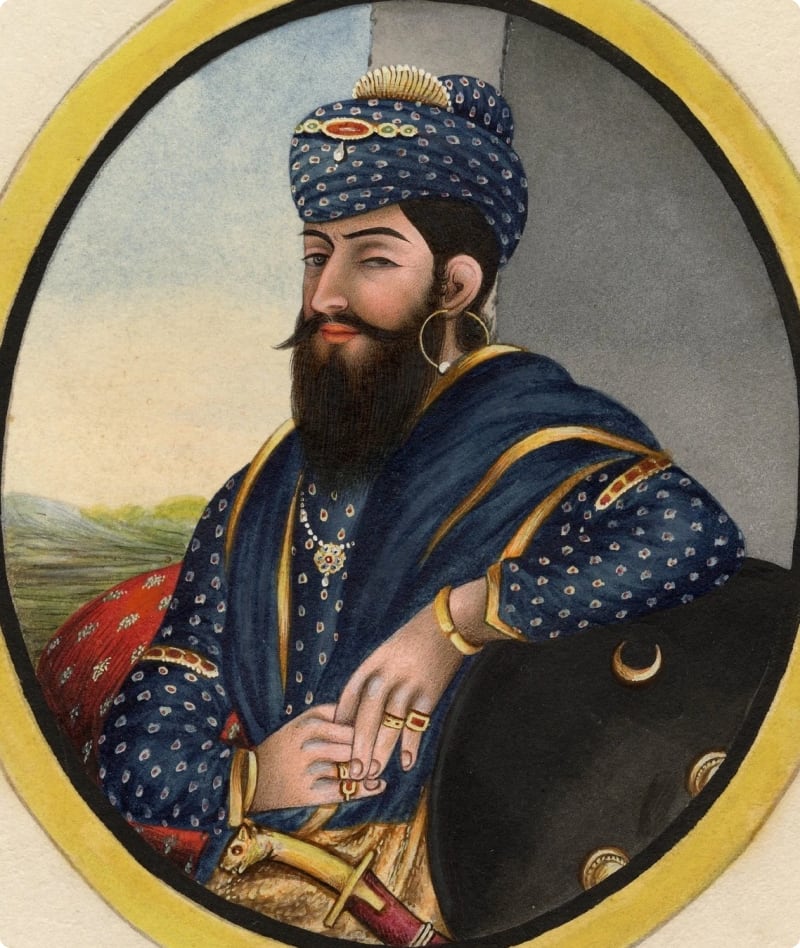
Against this backdrop of Sikh rule, Gulab Singh, a Dogra Rajput who had risen swiftly through the ranks of Ranjit Singh's army since joining in 1809, emerged as a key figure. Appointed as the Raja of neighboring Jammu in 1822, Gulab Singh embarked on a series of conquests in the surrounding regions, ostensibly on behalf of the Sikh state, but in reality, "much of the region, including Kishtwar, Iskardu, and Ladakh, passed under his personal control" (Singh 36). The British East India Company's tacit encouragement of these forays, motivated by the prospect of diverting the lucrative Tibetan shawl wool trade to British India, foreshadowing their future political meddling (Huttenback 479).

The death of Maharaja Ranjit Singh in 1839 plunged the Sikh Empire into a period of political instability and succession struggles, a development that Gulab Singh sought to capitalize on by aligning with the ascendant British power. As tensions between the Sikhs and British escalated in late 1845, Gulab Singh repeatedly reached out to British officials, offering collaboration against the Sikhs in exchange for recognition of his sovereignty over Jammu. His overtures culminated in a promise of cooperation to Major Broadfoot, the Governor-General's agent: "The Rajah wishes to be taken by the hand... he says he will carry out to the utmost whatever orders may be given by the English Government" (Singh 41).
Emboldened by British recognition of his committal, Gulab Singh actively undermined the Sikh war effort, withholding critical supplies and reinforcements from the Sikh army. "One such application by Runjore Singh Majithia, a prominent Sikh chief, was turned down with the jibe that he had already abandoned too much while fleeing from the sites of earlier defeats" (Singh 48). These actions demoralized the Sikh soldiers, who "expressed their readiness to accept any settlement with the British so long as it did not involve a reduction in their salaries" (Singh 49), further weakening the Sikh position.

In the wake of the decisive Sikh defeat at Sobraon, Gulab Singh assumed a leading role in negotiating the Treaty of Lahore. As the chief representative of the Sikhs, he persuaded them to accept humiliating terms, including the cession of extensive territories and the payment of a massive indemnity. The British, hesitant to expand direct rule into what was then an extremely exposed position, recognized Gulab Singh's own interests (Lamb 55), and the Treaty included an article stating that he would be made an independent ruler of "such territories in the hills as may be made over to [him] by separate agreement" (Singh 54).
This separate agreement, the Treaty of Amritsar, was concluded a week later between the British and Gulab Singh. Its "signing conjured into existence the princely state of Jammu and Kashmir," as "disparate territories stripped by the Company from the Sikh kingdom of Punjab were cobbled together to bring [it] into being" (Rai 31). Over the next two years, with the aid of the British military, Gulab Singh consolidated his authority over this new state. However, the regional perception of the treaty as a "sale-deed" that once again disregarded the autonomy or voice of the Kashmiri people in exchange for political pandering underscored the sense of disenfranchisement that would prove a recurring theme in the region's subsequent history (Rai 32).
The Treaty of Amritsar also stipulated that the newly established princely state of Jammu and Kashmir would be indebted to the British crown and expected to provide military assistance in the event of armed conflicts. The Dogra state appeared to honor this condition, as evidenced by "Maharaja Ranbir Singh providing troops to quell the revolt of 1857 in British India" (Zutshi 62). This bond of fealty, coupled with the British need for the region to serve as a strategic buffer zone against Russia and Afghanistan, ensured that the Dogra dynasty "was thoroughly intertwined with the project of British colonialism in mid-nineteenth-century India." To secure this relationship, "the British began a policy regarding Kashmir which was geared toward endowing Gulab Singh's dynasty with the ideals of legitimate rule" (Zutshi 140).

One of the primary sources of Muslim grievances under Dogra rule was the subordinate and discriminatory treatment of Islam compared to the privileged position accorded to Hinduism by the Dogra maharajas in their capacity as rulers of a "Hindu state." This legitimizing Hinduness manifested in policies such as "the revival of a law banning cow-slaughter that had been introduced and then rescinded during the Sikh regime; the construction of temples throughout the state; and the establishment of institutions such as the Dharmarth" (Zutshi 61).
The oppressive nature of Dogra rule was encapsulated by Walter Lawrence, a British settlement officer, who condemned how "the officials systematically endeavored to make themselves feared by the people" and extract maximum resources from the Muslim cultivating classes, who suffered under excessive tax rates, forced labor (begar), and onerous tithes (Rai 157). In contrast, the Dogras bestowed extensive land holding privileges on Hindus, particularly Kashmiri Pandits, through generous "chakdara" grants, exemptions from begar, lighter tax rates, and other benefits "to encourage them to settle in Kashmir so that the maharaja would have 'a certain body of his own people ready at hand in the event of any disturbances in the valley'" (Rai 168).

The late 19th century posed significant challenges for the Dogra state, notably the devastating famine of 1877-79, which resulted in substantial loss of life and exposed the administration's inadequacies in crisis management. "Even more critically, the Kashmir durbar's attitude during the famine had demonstrated its incapacity to rise above the preferential treatment of its already privileged Hindu subjects to the detriment of Muslim cultivators who were the greatest sufferers" (Rai 151), further exacerbating communal tensions.
During the reign of Maharaja Pratap Singh (1885-1925), the Dogra state continued to emphasize and reinforce the religious identities of its subjects, categorizing them primarily as either Hindu or Muslim, in line with the policies of previous Dogra rulers. However, Pratap Singh's regime departed from its predecessors by asserting that representing the interests of these distinctly defined groups was a duty of the ruler, a declaration that marked the critical recognition of religious lines within the legal language of the Dogra state. While this could be interpreted as a step towards a more inclusive governance model that acknowledges and addresses the needs of diverse groups, in practice it perpetuated policies of favoritism, with the difference being that "these divisions were now 'sectarian' and hence irreconcilable" (Zutshi 155).

The explicit recognition of religious identities and the state's commitment to represent these identities within its framework fueled an increased assertiveness among Kashmiri Muslims, who began to demand greater rights and better representation within the state's governance structures. Feeling marginalized by the predominantly Hindu Dogra rulers, the Muslims of Kashmir started to assert their identity more forcefully, calling for equal treatment and greater inclusion in state affairs. A notable example of this growing assertiveness was a memorandum addressed to the Viceroy in 1909 on behalf of "representatives of the Kashmiri Mussalmans," which "spoke of the hopes of all Kashmiri Muslims, which only the British Resident could guarantee, for 'justice and safety' from a spirit of 'Hindustan for Hindus' that had begun to pervade the Kashmiri Pandits and Punjabi Hindus employed in the state" (Rai 246).

Building on these early mobilizations, the early 20th century witnessed a burgeoning of nationalist sentiments in Kashmir. In 1932, the British imperial government intervened in an attempt to bridge the growing divide between the Hindu state and its Muslim subjects through the Glancy Commission and a newly drafted Constitution. However, these measures proved to be too little, too late. By this point, "a party had been established by a group of Kashmiri patriots including Sheikh Abdullah and Mirwaiz Mohammed Yusuf Shah, the All Jammu and Kashmir Muslim Conference, which became the major vehicle for opposition to the Maharaja" (Lamb 92).
Under Sheikh Mohammad Abdullah's leadership, the Muslim Conference underwent a significant transformation in 1939, evolving from a Muslim-centric platform into the avowedly secular-socialist National Conference (NC) that embraced a pan-Kashmiri identity transcending religious affiliations. "Undoubtedly, the leadership intended to present the Conference as an organization of the downtrodden classes. Its flag, for instance, was red in color with a white plough in the center, representing socialist revolution for the Kashmiri peasantry" (Zutshi 270). The NC's vision of democratic self-governance and autonomy within a secular India aligned with the rising anti-colonial and anti-feudal currents sweeping across British India.

As the princely state of Jammu and Kashmir entered its final years, the political landscape underwent significant changes with the growing influence of the Muslim League and the Indian National Congress, two major parties from British India, on Kashmiri politics. Sheikh Abdullah's National Conference made concerted efforts to bridge the divide between Kashmiri Pandits and Muslims in response to these growing political challenges. Consequently, many Pandits rallied to the Conference and its resulting alignment with the Indian National Congress, primarily for "'the cause of Indian nationalism . . . [because], despite the statements of the Congress leaders to the contrary, [it] was becoming another name for Hindu nationalism'" (Rai 286).
However, the emergence of a pro-Pakistan faction within the Muslim Conference, a breakaway group from the National Conference, further complicated the situation. Dominated by urban Jammu Muslims and seeking to counter their increasing political marginalization in Kashmir and within the NC, this faction aligned itself with the Muslim League and Mohammad Ali Jinnah. Jinnah's visit to Kashmir in 1944 brought these political fault lines into sharp relief, as he received a warm welcome from the pro-Pakistan groups while facing a rebuff from the National Conference (Rai 287).

The in-fighting between the pro-Pakistan Muslim Conference and the ostensibly secular-nationalist National Conference in the lead-up to the partition of British India was more than a mere political rivalry. It was a manifestation of the profound divisions that had been etched into the fabric of Kashmiri society over its recent history of external domination and internal strife. This ideological rift, fueled by the machinations of the Muslim League and the Indian National Congress, laid bare the fragility of Kashmiri unity and the daunting challenge of forging a shared vision for the future in the face of deeply entrenched sectarian and regional loyalties. It represented the tragic culmination of the divide-and-rule policies of the Dogra Dynasty and their reinforcement by British indirect rule. As the Maharaja's controversial accession to India and the outbreak of the First Indo-Pakistani War signaled the start of a violent new chapter in Kashmir's history, it also served as a symbolic boiling point for the historical forces that had shaped the region's troubled past and continue to define its uncertain future.
Works Cited
- Huttenback, Robert A. (1961), "Gulab Singh and the Creation of the Dogra State of Jammu, Kashmir, and Ladakh" (PDF), The Journal of Asian Studies, 20 (4): 477–488, doi:10.2307/2049956, JSTOR 2049956, S2CID 162144034, archived from the original (PDF) on 15 August 2016
- Lamb, A. (1992). Kashmir : a disputed legacy, 1846-1990. Oxford University Press.
- Rai, M. (2017). Hindu rulers, Muslim subjects: Islam, rights, and the history of Kashmir. Permanent Black.
- Singh, Bawa Satinder (1971), "Raja Gulab Singh's Role in the First Anglo-Sikh War", Modern Asian Studies, 5 (1): 35–59, doi:10.1017/s0026749x00002845, JSTOR 311654, S2CID 145500298
- Zutshi, C. (2004). Languages of belonging: Islam, regional identity, and the making of Kashmir. Hurst & Co.