Damascus
Fall 2022
The Great Mosque of Damascus, an architectural marvel of the Umayyad dynasty, stands as a testament to the confluence of artistic traditions and the political aspirations that shaped the early Islamic world (Dickie, 1897). Constructed between 707 and 714 CE under the patronage of Caliph Al-Walid I, the mosque embodies the Umayyads' vision of a unified and powerful Islamic state, one that could rival and even surpass the cultural achievements of the Byzantine and Persian empires.
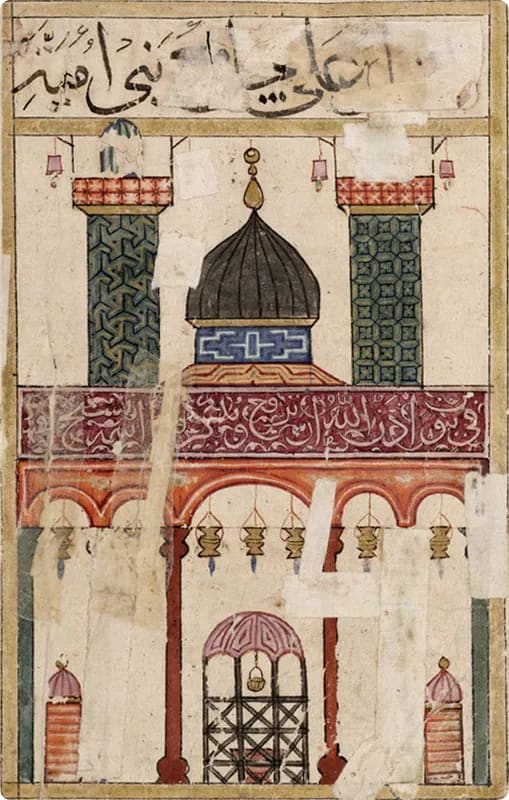
The mosque's historical context is inextricably linked to the rise of the Umayyad caliphate, which sought to establish its legitimacy and authority through grand architectural projects that fused Islamic, Byzantine, and Roman traditions . The choice of Damascus as the Umayyad capital was a strategic move, capitalizing on the city's long history as a center of trade, culture, and religious significance. By erecting the Great Mosque adjacent to the caliph's palace and atop the ruins of a Roman temple to Jupiter and a later Christian cathedral dedicated to St. John the Baptist , the Umayyads asserted their political and religious supremacy while acknowledging the city's diverse cultural heritage.
The mosque's architectural design reflects a masterful synthesis of influences from the region's pre-Islamic past. The reused Roman columns, Corinthian capitals, and ornamental moldings throughout the complex (Dickie, 1897) demonstrate the Umayyads' appropriation of classical architectural elements as a means of asserting their own power and legitimacy. The incorporation of Byzantine-inspired mosaics depicting lush landscapes and vibrant vegetation, reminiscent of those adorning the Dome of the Rock in Jerusalem, further underscores the Umayyads' engagement with the artistic traditions of the conquered territories.

Yet, the Great Mosque of Damascus is not merely a pastiche of borrowed elements; it represents a unique and innovative architectural solution that adapted these influences to serve the needs of Islamic worship (Flood, 2001). The mosque's rectangular plan, measuring approximately 157 by 100 meters (515 by 330 feet) , features a vast courtyard (sahn) to the north and a hypostyle prayer hall (haram) to the south. This layout, with its emphasis on communal gathering spaces and clear orientation towards Mecca, set a precedent for mosque design that would be emulated across the Islamic world.
The prayer hall, crowned by the magnificent 36-meter (118-foot) high "Dome of the Eagle," is a breathtaking display of the Umayyads' architectural prowess . Three arcades, running parallel to the qibla wall and adorned with the second oldest mihrab in Islamic history, create a sense of rhythmic unity and guide the worshippers' gaze towards the sacred direction of prayer. The use of horseshoe arches in the arcades, a motif that would become a hallmark of Islamic architecture from Cordoba to Samarkand, is an early example of the Umayyads' experimentation with new architectural forms that would come to define the Islamic aesthetic (Dickie, 1897).
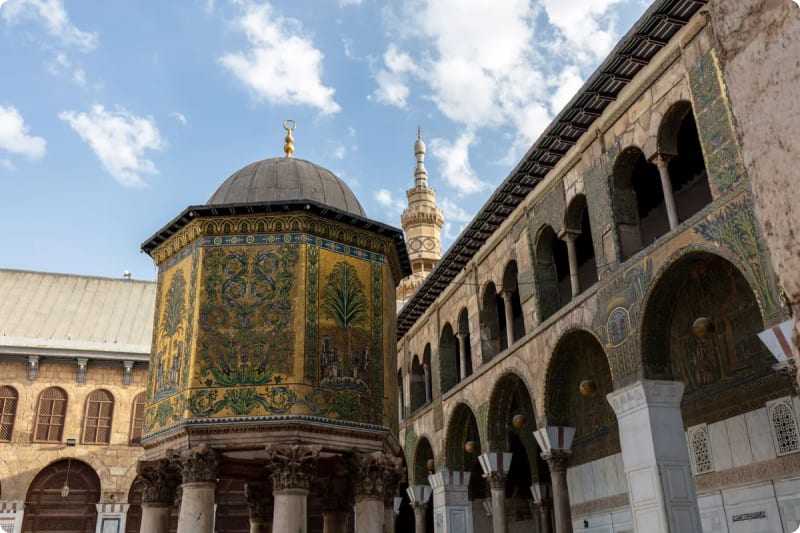
The mosque's courtyard, slightly larger than the prayer hall, serves as a gathering space for the faithful and a symbolic representation of the Umayyads' power. The presence of a sacred treasury within the courtyard, as noted by Dickie , underscores the mosque's role as not only a place of worship but also a repository of the empire's wealth and a symbol of the caliph's divinely ordained authority.
The legacy of the Great Mosque of Damascus extends far beyond its immediate historical context. As one of the oldest and most revered mosques in Islam, it has served as a model for countless other mosques across the Islamic world, from the Great Mosque of Cordoba in Spain to the Qairawan Mosque in Tunisia (Dickie, 1897). Its influence can be seen in the adoption of the hypostyle plan, the use of the mihrab and minaret, and the incorporation of decorative elements such as mosaics and carved stone ornament.
Moreover, the mosque stands as a powerful symbol of the Umayyad caliphate's cultural and political achievements. Its grandeur and sophistication reflect the wealth and power of the Umayyad state, while its fusion of diverse architectural traditions embodies the cosmopolitan nature of early Islamic society. As Ingersoll notes, "This fusing of the mosque with the palace compound drew upon the Byzantine precedent of combining temporal and religious authority, notably in Constantinople, where the imperial palace connected to Hagia Sophia" . By situating the mosque within the broader context of imperial patronage and the interplay of religious and political power, we can better appreciate its significance as a statement of Umayyad ambition and a marker of the dynasty's place in the annals of Islamic history.
The Great Mosque of Damascus, with its architectural innovations, synthesis of diverse influences, and enduring legacy, represents a turning point in the history of Islamic architecture (Dickie, 1897). It marks the emergence of a confident and distinctly Islamic architectural tradition, one that would shape the built environment of the Islamic world for centuries to come. As a testament to the cultural and political dynamism of the early Islamic period, the mosque stands as a reminder of the power of architecture to embody and express cultural identity, to forge connections across time and space, and to inspire generations of artists, architects, and worshippers alike.

In conclusion, the Great Mosque of Damascus is a masterpiece of Umayyad architecture and a key monument in the history of Islamic art and architecture (Dickie, 1897). Through its seamless integration of Roman, Byzantine, and Islamic architectural elements, its innovative spatial organization, and its role as a model for future mosque designs, the Great Mosque of Damascus encapsulates the cultural, political, and religious aspirations of the Umayyad dynasty and the early Islamic world. As scholars continue to unravel the complexities of its construction history and decipher the symbolic meanings embedded in its walls, the mosque remains a potent symbol of the enduring legacy of Islamic civilization and a testament to the transformative power of architecture.
Works Cited
- Ingersoll, Richard. World Architecture: A Cross-Cultural History. Oxford University Press, 2020.
- Dickie, A. C. (1897). The Great Mosque of the Omeiyades, Damascus. Palestine Exploration Quarterly, 29(4), 268-282. https://doi.org/10.1179/peq.1897.29.4.268
- Flood, F. B. (2001). The Great Mosque of Damascus: Studies on the making of an Umayyad visual culture. Brill.