The Erosion of Place
Spring 2024
In the aftermath of World War I, while much of Europe struggled to rebuild in the face of staggering devastation, the United States emerged as a global economic powerhouse. Spared from the ravages of war, the country's economy roared into the "Roaring Twenties." Returning soldiers swelled the workforce, powering an era of relentless industrialization and technological progress. This surge of modernity fueled a vibrant consumer culture, and the Art Deco movement arose as its aesthetic embodiment. The movement, which reached its zenith in the 1920s and 1930s, ushered in a rich array of visual styles that embraced an early modernity while reflecting elegance, functionality, and simplicity.
The origins of the Art Deco style can be specifically traced back to the International Exhibition of Modern Decorative and Industrial Arts held in Paris in 1925. Designed to showcase new styles in art, design, and architecture, this exposition promoted French artistry and manufacturing while introducing the term "Arts Décoratifs" – from which the eventual name "Art Deco" was derived. In its inspirations and expressions, Art Deco drew eclectically from a variety of stylistic sources. The movement's geometric underpinnings found roots in the cubist artworks of the early 20th century, with its emphasis on deconstructed forms and angular faceting. Vibrant colors and aesthetics were influenced by the bright, avant-garde Fauvist painters. And exotic decorative elements paid homage to the symbolic styles of cultures like ancient Egypt, Asia, and Mesoamerica. But ultimately, Art Deco's most distinctive inspiration was the machine age itself – the sleek lines and industrial materials embodied modernity's optimistic embrace of technology and progress.

The architectural incarnations of Art Deco were characterized by several defining elements. The style made prominent use of newly available industrial materials like stainless steel, aluminum, chrome plating, and inlaid wood veneers. Art Deco buildings frequently featured streamlined curved forms, sharp angles, and repeating geometric patterns like chevrons, zigzags, and stylized floral or sunrise motifs. A bold sense of verticality was often conveyed through setbacks and ornamental caps that conveyed a sense of height and grandeur befitting the modern age.
Above all, Art Deco represented a distinctly 20th century aesthetic aimed at evoking themes of progress, sophistication, and technological achievement. Whether through office towers, industrial facilities, public monuments or residences, the style fused modernist design principles with decorative visual flair – essentially priming the tradition of architectural ornamentation and monumentality for an era of industrialized urban growth.
However, as the Great Depression took hold at the end of the 1920s, the economic climate dramatically shifted. There was a growing need for a new aesthetic that aligned more closely with the emerging ideals of simplicity, functionality, and accessibility to a broader audience. This economic backdrop paved the way for the emergence of Streamline Moderne, a style that evolved from Art Deco and its industrialized ethos while placing a diverging focus on smooth lines, aerodynamic forms, and minimal ornamentation.
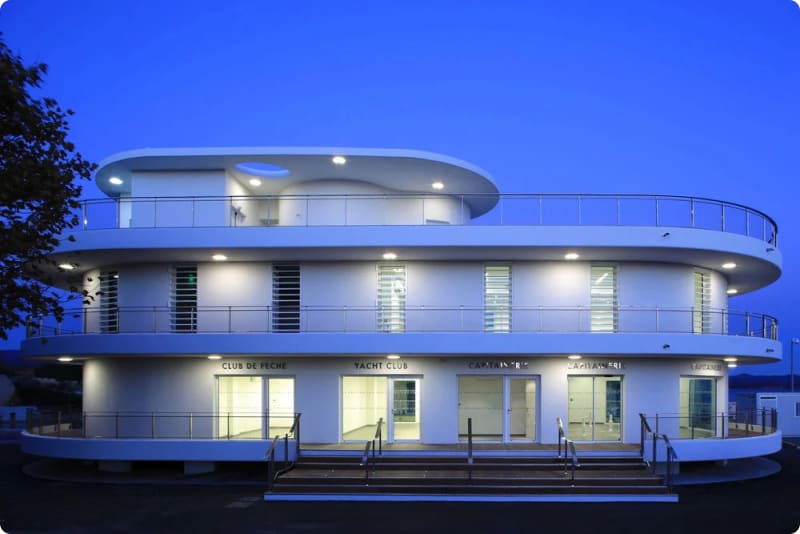
While certainly a reflection of the adverse economic environment, Streamline Moderne’s removal and replacement of Art Deco ornaments and sharp geometric lines was also heavily influenced by the principles of aerodynamics derived from the automotive and aeronautical industries, as well as the burgeoning Soviet constructivism movement. This influence was evident in its architectural expressions, which featured sleek, rounded forms that suggested movement and speed. Buildings and objects often had horizontal lines that emphasized their length and fluidity, creating a sense of streamlined motion. The style also embraced new materials such as chrome, stainless steel, and Bakelite, which were not only modern but also more affordable and practical.
In terms of color and decoration, Streamline Moderne marked a departure from the vibrant, contrasting palettes of Art Deco. Instead, it favored more subdued and monochromatic color schemes that enhanced its sleek and uncluttered look, a reflection of the style's economic pragmatism and emphasis on function over form. This streamlined aesthetic often found its way into popular culture, particularly in early science fiction films that used Streamline Moderne designs to signify visions of the future and technological progress.
Moreover, Streamline Moderne was more than just an aesthetic adjustment; it represented a cultural shift towards modernity and industrial progress, aligning with the societal embrace of technological advancements and mass production. This was visible not only in architecture but also in various forms of industrial design, including automobiles, trains, and household appliances, which adopted the aerodynamic and minimalist features characteristic of the style.
In timely fashion, however, the overly aestheticized nature of Streamline Moderne’s form and ethos would soon be eschewed by architectural authorities, driven by the exigencies of a world emerging from the devastation of World War 2. Consequently, the transition from Streamline Moderne to post-war modernism encapsulates a period of profound change and innovation, This era marked a departure from the aerodynamic, nautical forms of Streamline Moderne to a more austere and functional approach that addressed the urgent needs for rebuilding, housing, and reimagining urban life.
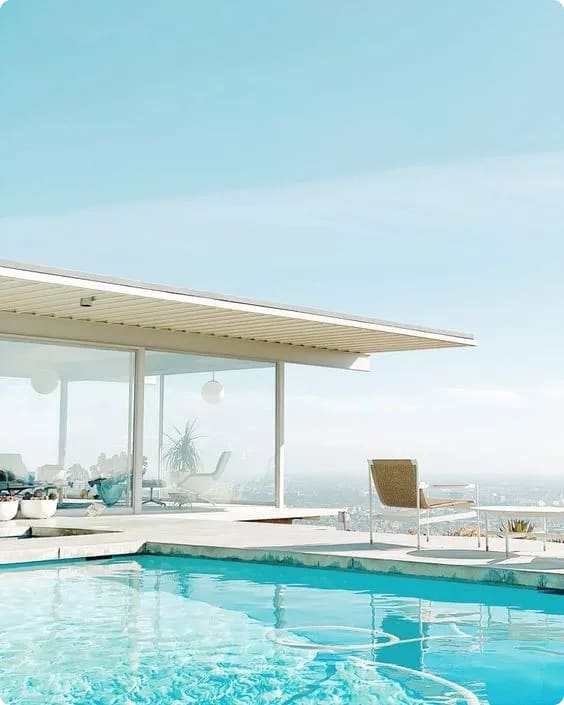
In the immediate post-war period, European cities faced the colossal task of rebuilding amidst ruins. Architects like Auguste Perret in France were at the forefront, pioneering the use of reinforced concrete to address the dual needs of durability and speed in construction. Perret's approach was pragmatic yet innovative; his work in the reconstruction of Le Havre exemplifies the application of modular designs and prefabrication techniques, setting a precedent for modernist architecture that emphasized functionality and cost-effectiveness. This method was not merely a technical solution but also a means to rapidly provide urban housing and civic buildings, which were crucial for societal recovery.
As exemplified by Perret’s Le Havre, Modernism, which had been steadily gaining momentum since the turn of the century, represented an outright rebellion against the ornamental historicism and revivalist styles that dominated 19th century architecture. Modernist architects like Le Corbusier, Walter Gropius and Mies van der Rohe promoted an entirely new typology of building focused on pure functionality, simplicity, and the honest expression of materials like steel, concrete and glass.

Rejecting the traditional design elements of previous eras, Modernist structures were defined by their strip windows, free-flowing open interiors, and lack of unnecessary decoration. Form fundamentally followed function, giving rise to buildings that were stripped bare of superfluous elements. This distinctly 20th century aesthetic aimed to create affordable, versatile spaces perfectly engineered for their intended uses and contexts.
The Modernist movement drew significant influence from pioneering initiatives like the Bauhaus school in Germany. Founded in 1919, the Bauhaus pioneered a radical pedagological model focused on integrating traditional craft disciplines like architecture and design with emerging industrial technologies and materials. This cross-pollination fostered some of modernism's signature principles like emphasizing volume over mass, favoring balanced asymmetrical forms, and adopting machine-age minimalist aesthetics as a universal design language.
As Modernist ideologies rippled from their European crucibles, they congealed into the definitive International Style by the 1930s. Though few buildings had fully adhered to its principles yet, the movement's aesthetics and vision were comprehensively codified by architectural critics Henry-Russell Hitchcock and Philip Johnson in their catalyzing 1932 Museum of Modern Art exhibition. Hitchcock and Johnson's International Style was characterized by its stark minimalism, transparency of forms via expansive glass curtain walls, and lack of exterior ornament or culturally-specific references. Reflecting modernism's machine-age ideologies, the style aimed to create buildings whose sleek, functional aesthetics could be universally understood across cultures and transcend nationalist tastes.
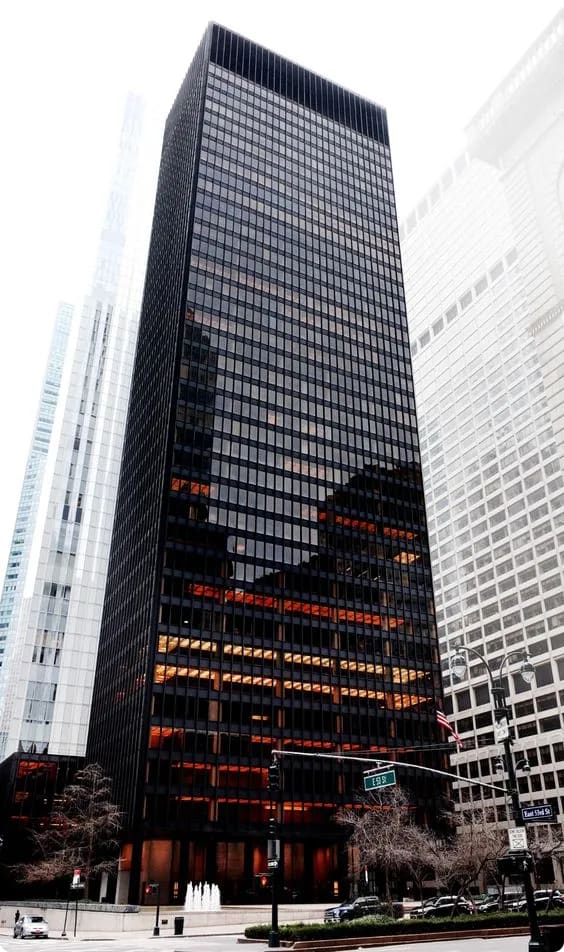
In addition to corporate buildings, the International Style also profoundly influenced residential architecture. Developments like the Unité d'Habitation by Le Corbusier introduced new concepts of communal living with shared facilities, reflecting the style's emphasis on social functionality. Despite its widespread adoption, the International Style was not without its critics. Some argued that its universal approach often ignored local contexts, climates, and cultures, leading to environments that could be seen as impersonal or alienating. Over time, these criticisms would give rise to various postmodern movements that sought to reintegrate historical styles and local traditions into architectural practice.

In the United States, the Mid-Century Modern movement evolved from the International Style but incorporated more organic forms and a greater integration with the environment. This style catered to the burgeoning suburban lifestyle of the 1950s America, emphasizing comfort and domesticity along with functionality. Architects like Frank Lloyd Wright, who advocated for an architecture harmonious with its surroundings, influenced this movement significantly. Wright's Guggenheim Museum, with its unique spiral form and integration with the urban landscape, exemplifies the innovative spirit of this era, which combined aesthetic boldness with practical concerns.
Brutalism emerged too as a stark, formidable style characterized by the extensive use of concrete and bold geometric shapes. As a continuation of modernist principles, Brutalism emphasized material honesty and structural expressiveness but also introduced a robust, often monumental aesthetic that stood in contrast to the perceived lightness and superficiality of some earlier modernist works. Brutalism was deeply intertwined with social and ethical considerations, aiming to produce buildings that symbolized civic pride and collective values. The Barbican Centre in London and the Boston City Hall are quintessential examples, reflecting the aspirations and complexities of urban planning during the mid-20th century.

The origins of modernism reveal how avant-garde architecture is, at its root, a celebration of the unique societal forces catalyzing each new era of human experience. A similar innovative spirit propelling Art Deco would course through the coming rise of the International Style and modernist architecture. Though aesthetics transitioned, both emerged as distinct reflections of their respective generational zeitgeists – emblems of humankind's continuously evolving efforts to encode its creative ambitions into the built world.
The International Style's minimalist aesthetic and emphasis on functionality would dominate architecture for decades. However, as multinational corporate entities began accelerating their ascent in the late 20th century’s economic sphere, these integral principles became distorted, yielding buildings disconnected from their contexts and the people who inhabit them. Stripped of its modernist philosophical core emphasizing clean functionality attuned to local needs, minimalism transmogrified into a marketing gambit of global branding firms. Towering monoliths of steel and glass replicated their sleek, generic exoskeletons from Manhattan to Shanghai – severing each city's built heritage from regionally-specific cultural and material lineages.
Take, for example, the placeless, decontextualized phenomenon embodied by Dubai's Burj Khalifa. An 800 meter obelisk which stands in stark contrast to the ideological ambitions and contextual attunement of earlier landmark works from the same architectural firm, Skidmore, Owings & Merrill (SOM). Their iconic Sears Tower (now Willis Tower) in Chicago, completed in 1973, exemplified modernism's drive to advance structural innovation and technology in direct resonance with the urban fabric. The tower's distinctive bundled tube design allowed unprecedented height through an elegant, efficient use of materials creating a visually striking yet contextually-integrated form on the city's skyline. Its varied floor plates suited for different programmatic needs demonstrated modernism's commitment to elevating functionality in a way that redefined the skyscraper.

In contrast, while certainly a technological marvel, the Burj Khalifa emphasizes sheer skyscraping spectacle over integrated structural expressionism responsive to its context. The tower's deferential aesthetic has no resonance with the Arabian peninsula's indigenous architectural lineages adapting to the desert climate over centuries. Its glazed corporate exoskeleton ignores thousands of years of evolved knowledge favoring thermally-massive construction, climatically-responsive shading, and spatial strategies nurturing community cooling patterns. Instead, the Burj is essentially an air-conditioned glass monolith with no deeper dialogue between its form and local geographic identity. Prioritizing height records over human-scaled spatial use or true innovation in skyscraper typologies, the Burj represents the inverse of the Sears Tower's embedded contribution to Chicago's identity.
This aesthetic shift from the rigorously functional/contextual approach of SOM's earlier work to the Burj's deracinated photo-op sculptor epitomizes the critique of contemporary architecture's devolution into placeless branding exercises. Rather than thoughtfully evolving modernist principles, the Burj commodifies its stylistic tropes, disassociating form from deeper inquiries into culturally-resonant structural expressions and human-scaled programmatic performance.
This divergence of intrinsic value between architectural past and present is certainly not confined to the realm of the International Style and contemporary uninspired renditions; in fact, it can be found across nearly all the transformative moments that propelled Modernism through the 20th century. For example, tracing the functional rigor of Brutalism to the spectacle-driven rigor of its contemporary counterpart showcases such dramatic devolution in design philosophy.
Designed by Louis Kahn in the 1960s, the Salk Institute is an iconic example of brutalist architecture, a style that emphasizes raw concrete construction, geometric forms, and a strong sense of functionality. Situated in La Jolla, California, the institute leverages its environment effectively, with its structures framing the vast expanse of the Pacific Ocean, integrating natural beauty into its stern, utilitarian layout. The use of unfinished concrete not only serves as a hallmark of brutalism but also offers durability and low maintenance, essential for a scientific research facility. The design's stark, robust appearance is softened by a linear water feature in the courtyard that adds a contemplative element to the space, enhancing the intellectual environment. This architectural approach underscores a philosophy where form is dictated by function, and beauty arises from the building's purpose and setting.

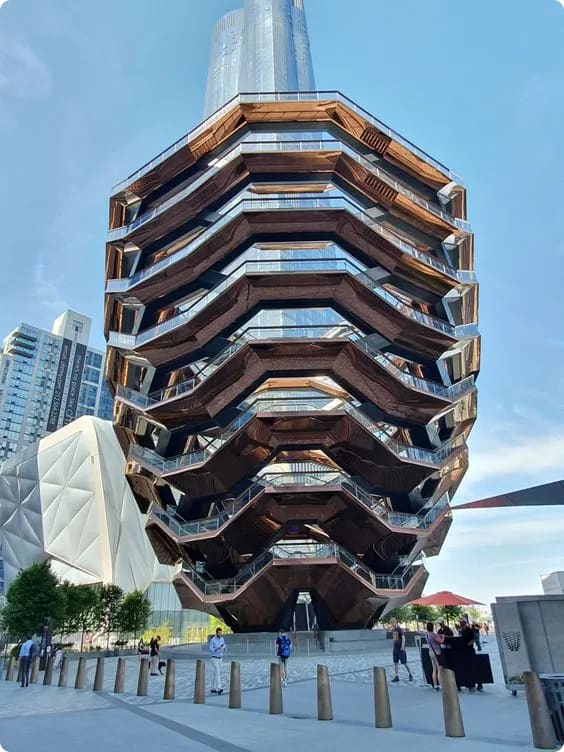
Conversely, the Vessel represents a departure from material and functional austerity. Designed by Thomas Heatherwick, it serves as a sculptural centerpiece in New York City's Hudson Yards. This structure is characterized by its intricate network of interlocking staircases, made from a shimmering copper-clad steel that reflects the light dynamically. Unlike the Salk Institute’s integration with its natural surroundings, the Vessel is designed to be a focal point, prioritizing aesthetic appeal and visitor interaction over traditional functionality. It functions primarily as a public viewing platform and a piece of interactive art, inviting visitors to climb and explore its elaborate form like a jungle gym for the 1%.
Architecture and structural design has lost a sense of meaning. Buildings are erected for the sole purpose of capitalist showboating or urban parading, and they are only given purpose through their hijacking of one’s attention. Rather than embodying the avant-garde ethos that catalyzed movements like Art Deco or embracing a rigid utilitarian dogma like the Bauhaus school, these contemporary placeless building typologies prioritize mere economies of scale, branding exercises for multinational corporate giants, and real estate profiteering over any conscious pursuit of rooted civic placemaking.
This trend of prioritizing grandeur over human scale isn't limited to iconic public buildings; it's also evident in the rise of the 'McMansion' in residential architecture. Just as Modernism devolved into corporate 'starchitecture' in the public realm, the McMansion represents a perversion of the very idea of 'home' as a place of belonging. The replication of identical architectural forms across different geographies contributes to what Marc Augé terms "non-places," spaces that lack the essence of community and historical continuity. These are areas designed for transit and consumption, devoid of social interaction or communal significance. The symptomatic proliferation of McMansions, a term that blends 'McDonald's' (symbolizing mass production) and 'mansion' (indicating size), have come to represent not just a tainted architectural style but also the ramifications of hopeless superficiality.
The design of McMansions frequently includes oversized rooms and unnecessarily complex rooflines, along with a mix of elements borrowed from historical styles such as Tudor, Mediterranean, or Colonial. This eclectic borrowing often results in a disjointed appearance that lacks cohesion. The interiors are similarly grandiose, with towering foyers and expansive, underutilized spaces, reflecting a prioritization of size over comfort or practicality.

In parasitic fashion, the spread of McMansions across suburban landscapes has contributed to a form of urban sprawl that prioritizes individual luxury over communal space and ecological health. This development pattern often leads to increased traffic, reduced walkability, and a loss of green spaces, further detracting from the sense of community and increasing the environmental footprint of neighborhoods. In essence, McMansions can be seen as architectural embodiments of short-sightedness, where immediate gratification is pursued at the expense of long-term sustainability and community well-being. They serve as a cautionary tale of the pitfalls of unchecked consumerism and the influential detriment of such projects like that of the self-aggrandizing Burj.
This disintegration of the profound human emplacement within architecture has corrosive ramifications that dissolve bonds between people and their habitats more corrosive than any mere aesthetic critique. Social fabrics strain as public realms transmogrify into privatized, commercialized, and automobile-oriented non-places. Civic life hollows as community forums like libraries, parks, and third places are supplanted by exclusionary, consumption-oriented pseudo-substitutes. Mental health wanes as existential disconnection from cultural-geographic rootedness severs people's senses of belonging. Ecological systems unravel as decontextualized development invades and eradicates indigenous habitats. Regional heritage endures a slow entropy as placeless built forms homogenize surrounding morphologies into cycles of demolition, reconstruction, and renewal devoid of historical resonance.
Perhaps most distressing is how this pandemic disrupts a core continuity in the human tale – the multi-millennial continuum of civilizations establishing geographic and cosmic identities through the symbiotic erection of material culture embedded within their landscapes. From Çatalhöyük to Tenochtitlan, the built artifacts constituting ancient cities emplaced their creators' stories into tangible, dwelled-in permanence. They manifested communal touchstones, ancestral resonances, and even ontological orientations tying disparate peoples together through what geographer Yi Fu Tuan termed "topophilia" – the ubiquitous human love of place. To sunder this elemental rapport with the architectural world amid modernity's onrush is to consign communities to a perpetual rootlessness – a haunting rupture of what grounds our species' self-actualizing identity as worldmakers and place-dwellers.
This essay commenced with the recent history of architecture and the fluidity of the last century of its development for a reason. Each iterative step forward was always preceded by urgency, a dynamic call to arms. Be it innovation, war, or Depression. Every carefully selected change in the status quo or reshaping of form and function was necessitated by a societal or cultural expediency. Art Deco was a definitive au revoir to the long 19th century, Streamline Moderne was an optimistic redirection by a domestic spirit that refused to be triumphed, and the International Style was a reflection of a world forced to interact on a global stage for the very first time. Then came our age of homogenized skyscrapers and soulless McMansions, necessitated by nothing, ushered in only by corporate avarice and loss of community.

As we've seen, architecture at its best connects us to a shared cultural identity and humanity's most fundamental needs - for beauty, meaning, and connection to each other and the natural world. When reduced to a vehicle for corporate vanity or nostalgic fantasies of prestige, it erodes the very foundations of human flourishing. The question facing architects, and all of us, is whether we have the courage to resist these forces and reclaim architecture as an art form in service of people and places.
Works Cited
- Ingersoll, Richard. World Architecture: A Cross-Cultural History. Oxford University Press, 2020.
- Frampton, Kenneth. Modern Architecture : a Critical History. London :Thames and Hudson, 1992.