The Colossus of Rhodes
Fall 2022
The Colossus of Rhodes, one of the Seven Wonders of the Ancient World, epitomized the cultural and technological achievements of the Hellenistic period. Erected between 292 and 280 BCE to commemorate Rhodes' victory over Demetrius Poliorcetes' siege, this monumental bronze statue of the sun god Helios embodied the city-state's resilience, prosperity, and artistic sophistication. This analysis explores the Colossus as a feat of architectural and sculptural innovation, its symbolic significance, and its enduring influence on art and architecture.

In the early 3rd century BCE, Rhodes emerged as a major maritime power in the eastern Mediterranean, capitalizing on its strategic location along crucial trade routes. This prominence drew the attention of the Macedonian ruler Antigonus I and his son Demetrius Poliorcetes, who sought to control the island. In 305-304 BCE, Rhodes withstood a protracted siege by Demetrius, repelling his technologically advanced siege engines and maintaining its independence (Kebric, 2019).
To celebrate their triumph and honor their patron deity Helios, the Rhodians commissioned the renowned sculptor Chares of Lindos to create a colossal statue using bronze from the abandoned Macedonian siege equipment (Pliny, 34.18.41). This project, funded by the spoils of war, symbolized Rhodes' transformation of conflict into cultural achievement.
Constructing a statue on the unprecedented scale of the Colossus posed significant engineering challenges. Chares, a student of the famed sculptor Lysippos, had to develop innovative solutions to ensure the monument's stability and durability (Maryon, 1956). The Colossus was built using an iron framework, around which bronze plates were cast and affixed (Philo of Byzantium, 4.1-6). This technique allowed for a more flexible and resilient structure compared to solid casting, enabling the statue to withstand wind and seismic activity.
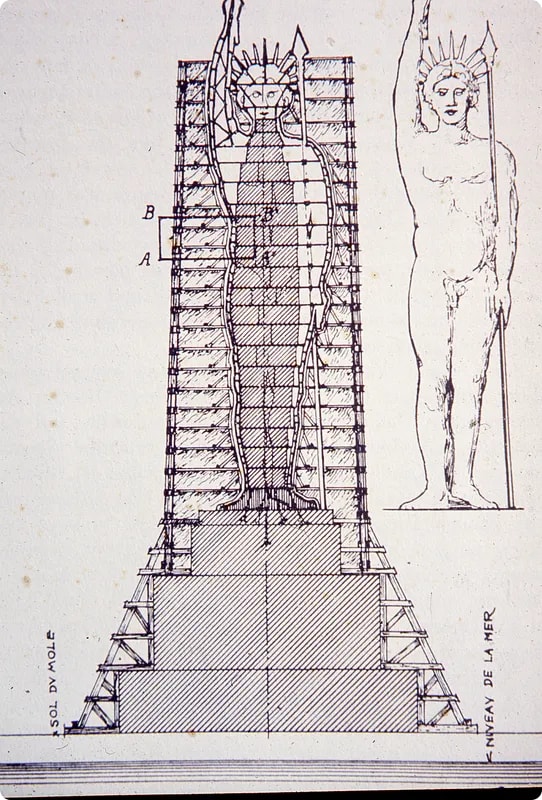
Moreover, the project required advancements in scaffolding and hoisting mechanisms. A complex system of pulleys, levers, and cranes was employed to lift and position the heavy bronze sections with precision (Gabriel, 1932). These groundbreaking construction technologies paved the way for future large-scale engineering projects in the Hellenistic world and beyond.
The completed Colossus, standing approximately 33 meters (110 feet) tall on a 15-meter (50-foot) white marble pedestal (Kebric, 2019), exemplified the Hellenistic artistic style. The statue depicted Helios as a nude male figure with a radiate crown, holding a torch aloft to guide ships into the harbor (Pliny, 34.18.41). Its colossal scale and dynamic pose represented a departure from Classical Greek sculpture's idealized restraint, embracing the Hellenistic era's emphasis on dramatic expression and emotional intensity.
The Colossus held profound symbolic meaning for Rhodes. As a representation of Helios, the statue served as a potent emblem of the city's prosperity, resilience, and cultural identity. Helios, the protector of seafarers and guardian of Rhodes' maritime trade, was an apt choice for the island's patron deity (Higgins, 1988).
Situated at the entrance to Rhodes' main harbor, the Colossus asserted the city's strength and confidence in the face of potential threats. Its creation from the spoils of war underscored Rhodes' ability to transform adversity into cultural triumph, repurposing the instruments of war into a monument celebrating their achievements (Kebric, 2019).
Although the Colossus stood for only 54 years before its destruction in an earthquake in 226 BCE (Strabo, 14.2.5), its impact on art and architecture endured. The statue's fame spread throughout the ancient world, inspiring awe and admiration even in its ruined state (Pliny, 34.18.41).
The Colossus set a new standard for monumental sculpture and engineering, influencing subsequent colossal statues such as Nero's Colossus in Rome (Suetonius, Nero, 31) and the Statue of Liberty in New York Harbor (Trachtenberg, 1976). Its innovative construction techniques, particularly the use of an iron framework, laid the groundwork for future architectural and engineering feats. Moreover, the Colossus epitomized the Hellenistic period's cultural and artistic values, characterized by a fascination with the colossal, the dramatic, and the emotionally expressive. It represented a pivotal moment in the development of art and architecture, bridging the idealized restraint of the Classical era with the experimentation and grandeur of the Hellenistic age.
The Colossus of Rhodes stands as a testament to human ingenuity, artistry, and resilience in the face of adversity. Its creation and enduring legacy encapsulate the complex interplay of technological innovation, cultural symbolism, and artistic expression that defined the Hellenistic period. Through its architectural and sculptural achievements, the Colossus not only embodied the spirit of Rhodes but also left an indelible mark on the history of art and architecture, inspiring generations of creators to push the boundaries of what is possible.
Works Cited
- Ingersoll, Richard. World Architecture: A Cross-Cultural History. Oxford University Press, 2020.
- Gabriel, A. (1932). La Construction, L'Attitude et L'Emplacement du Colosse de Rhodes (The Construction, Attitude and Location of the Colossus of Rhodes). Bulletin de Correspondance Hellénique, 56, 331-359.
- Higgins, R. (1988). The Colossus of Rhodes. In), The Seven Wonders of the Ancient World (pp. 124-137). Routledge.
- Kebric, R. B. (2019). The Colossus of Rhodes: Its Height and Pedestal. Athens Journal of Humanities & Arts, 6(4), 259-298. Maryon, H. (1956). The Colossus of Rhodes. The Journal of Hellenic Studies, 76, 68-86.
- Philo of Byzantium. (1889). De septem orbis spectaculis. In H. Diels (Ed.), Berliner Klassikertexte (Vol. 5). Georg Reimer.
- Pliny. (1952). Natural History, Volume IX: Books 33-35 (H. Rackham, Trans.). Harvard University Press. (Original work published c. 77-79 CE)
- Strabo. (1960). The Geography of Strabo (H. L. Jones, Trans.). Harvard University Press. (Original work published c. 7 BCE – 23 CE)
- Suetonius. (1914). The Lives of the Caesars (J. C. Rolfe, Trans.). Harvard University Press. (Original work published c. 121 CE)
- Trachtenberg, M. (1976). The Statue of Liberty. Viking Press.