The Church of San Marco
Fall 2022
The church of San Marco in Venice stands as a powerful testament to the city's singular ability to synthesize disparate cultural and artistic influences into a cohesive architectural expression of its unique identity and aspirations. Despite its modest origins as a small maritime settlement in the early 5th century CE, Venice rose to become a formidable economic and naval power in the medieval Mediterranean world. This ascent was facilitated by the city's strategic location, which allowed it to serve as a vital conduit for trade between the Byzantine Empire, the Islamic world, and Western Europe. Venice's distinctive political structure, characterized by a republican system of government led by an elected doge and a powerful merchant aristocracy, further contributed to its success by ensuring a degree of stability and continuity that was rare among its contemporaries.
The various factors at work within the wider context of Venice are illustrated in the architectural history of San Marco, which evolved over several centuries in response to Venice's changing fortunes and ambitions. The church's initial construction in the 11th century under Doge Domenico Contarini drew heavily on Byzantine precedents, particularly the now-lost Church of the Holy Apostles in Constantinople. Like its Constantinopolitan model, San Marco featured a Greek cross plan surmounted by five domes arranged in a quincunx pattern, a design that was virtually unknown in the Latin West at the time (Demus, 1960). This overt reference to the artistic traditions of the Byzantine Empire can be seen as a deliberate assertion of Venice's cultural and political alignment with the East, which was further reinforced by the incorporation of numerous Byzantine-style mosaics and precious marbles into the church's interior.

The sack of Constantinople by Venetian forces during the Fourth Crusade in 1204 marked a turning point in the history of San Marco and the city as a whole. The extensive loot brought back from the Byzantine capital, which included the famous bronze horses from the Hippodrome and the porphyry statues of the Tetrarchs, was prominently displayed on the church's facade as a triumphal monument to Venetian military prowess (Nelson). At the same time, the infusion of Byzantine artisans and artistic knowledge into Venice following the conquest led to a significant transformation of San Marco's interior, which was now embellished with an even greater profusion of glittering mosaics executed in the Byzantine manner (Demus, 1984).

However, it would be a mistake to characterize San Marco as a mere imitation of Byzantine models. Rather, the church represents a highly original synthesis of Byzantine, Islamic, and Western European influences that reflects Venice's unique position at the crossroads of these cultural spheres. This is particularly evident in the church's facade, which features a series of elaborate sculpted portals that draw on a wide range of sources, from the stone carvings of medieval Cairo to the Romanesque churches of southern Italy (Jacoff). The overall effect is one of dazzling eclecticism, a visual embodiment of Venice's cosmopolitan outlook and its ability to absorb and transform diverse artistic traditions.
The 13th-century mosaics of the church's interior, while firmly rooted in the Byzantine tradition, also display a distinctly Venetian sensibility in their iconography and style. The extensive cycle of mosaics in the atrium, for instance, presents a carefully crafted narrative of the life of Saint Mark that emphasizes his special relationship with the city and its people (Dale). Similarly, the mosaics of the baptistery, executed under the patronage of Doge Andrea Dandolo in the 1340s, offer a complex allegorical program that celebrates Venice's divinely ordained destiny and the role of the doge as the guardian of its spiritual and temporal well-being (Pincus).
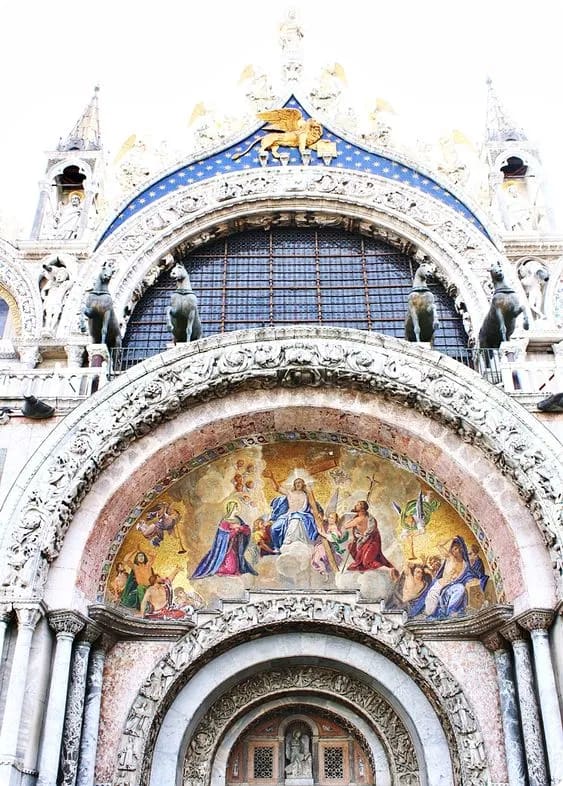
In addition to its rich mosaic decoration, San Marco is also notable for its innovative use of architectural elements and spatial arrangements to create a unified and immersive aesthetic experience. The church's atrium, with its complex interplay of vaults, arches, and domes, serves as a sort of theatrical prelude to the main body of the church, gradually revealing its splendors to the viewer as they progress through the space (Demus, 1960). Similarly, the carefully orchestrated lighting effects created by the church's multiple domes and windows contribute to an atmosphere of mystery and transcendence that is wholly distinct from the soaring, light-filled interiors of Gothic cathedrals.
Ultimately, San Marco's unique architectural character can be seen as a reflection of Venice's singular place in the political and cultural landscape of medieval Europe. As a city-state that owed allegiance to neither the Holy Roman Emperor nor the Pope, Venice was free to chart its own course and forge its own identity through its artistic and architectural patronage. In San Marco, the Venetians created a monument that eloquently expressed their self-image as a chosen people, blessed by divine favor and destined for greatness. By drawing on the prestige of Byzantium while also asserting their own cultural distinctiveness, they fashioned an architectural symbol of their city that would endure for centuries as a testament to the power and glory of the Venetian Republic.

In conclusion, the church of San Marco in Venice represents a masterful synthesis of Byzantine, Islamic, and Western European architectural traditions that embodies the city's unique identity and aspirations as a maritime power at the crossroads of East and West. Through its innovative use of architectural form, mosaic decoration, and symbolic imagery, San Marco asserts Venice's cultural and political independence while also proclaiming its divinely ordained destiny as a major force in the medieval Mediterranean world. As such, it stands as a powerful testament to the city's singular ability to absorb and transform diverse influences into a cohesive and compelling artistic vision.
Works Cited
- Ingersoll, Richard. World Architecture: A Cross-Cultural History. Oxford University Press, 2020.
- Dale, Thomas E. A. "Cultural Hybridity in Medieval Venice: Reinventing the East at San Marco after the Fourth Crusade." In San Marco, Byzantium, and the Myths of Venice, edited by Henry Maguire and Robert S. Nelson, 151-192. Washington, D.C.: Dumbarton Oaks Research Library and Collection, 2010.
- Demus, Otto. The Church of San Marco in Venice: History, Architecture, Sculpture. Washington, D.C.: Dumbarton Oaks Research Library and Collection, 1960.
- Demus, Otto. The Mosaics of San Marco in Venice. 4 vols. Chicago: University of Chicago Press, 1984.
- Jacoff, Michael. The Horses of San Marco and the Quadriga of the Lord. Princeton: Princeton University Press, 1993.
- Nelson, Robert S. "High Justice: Venice, San Marco, and the Spoils of 1204." In Byzantine Art in the Aftermath of the Fourth Crusade, edited by P. Vokotopoulos, 143-151. Athens: Christian Archaeological Society, 2007.
- Pincus, Debra. "Andrea Dandolo and the Fourteenth-Century Mosaics of the Baptistery." In San Marco, Byzantium, and the Myths of Venice, edited by Henry Maguire and Robert S. Nelson, 245-271. Washington, D.C.: Dumbarton Oaks Research Library and Collection, 2010.