Beyond Eden: Bosch's 'The Garden of Earthly Delights'
Fall 2023
In an era dominated by artistic conventions that depicted religious narratives with solemn reverence, Hieronymus Bosch's "The Garden of Earthly Delights" emerges as a striking deviation from the norm. This 15th and 16th-century masterpiece defies the period’s strict adherence to ecclesiastical dogma, employing religious iconography and accepting papal patronage not to instruct or inspire piety but as a framework to explore concepts absent in the contemporary canon. Bosch's intricate landscapes, populated by fantastical creatures and enigmatic symbolism, explore the tensions between innocence and corruption, desire and consequence, casting a prescient gaze upon the depths of the human psyche. In this striking departure from the era's artistic traditions, Bosch not only challenges the viewer to reconsider the nature of sin and virtue but also foreshadows the modern psychological odyssey into the unconscious and the complexities of the constructed self.

The triptych format has traditionally been a narrative tool, akin to the unfolding pages of a sacred text, revealing a hallowed sequence of events. The central panel, which naturally draws the viewer's focus, is encased by wings that not only enhance but also provide deeper insight into the central tableau's themes. This structure serves not only as a vessel for the narrative but also as a metaphor for the Christian Holy Trinity, with its threefold nature mirroring the Father, Son, and Holy Spirit. The physical design of the triptych, with its capacity to be opened and closed, mirrors the spiritual transition from the worldly to the divine, akin to the unveiling of spiritual truths.
Hieronymus Bosch's "The Garden of Earthly Delights" represents a radical departure from this conventional narrative arc, opting instead for a labyrinthine visual narrative that eschews linear storytelling and didactic clarity. The left panel, typically reserved for Edenic origins or divine proclamations, is instead a tableau of an otherworldly paradise. Central to this panel are the figures of Adam, Eve, and a youthful deity bearing Christ's likeness, set amidst a menagerie of exotic animals such as the giraffe and the elephant, which would have been foreign and wondrous to Bosch's contemporaries. These animals, alongside the more fantastical creatures, populate the landscape in a way that suggests a paradise that is not only a place of innocence but also one of inherent strangeness and complexity. This complexity is mirrored in the expressions and postures of Adam and Eve, who are depicted with a sense of curiosity and bewilderment rather than the usual tranquility.
However, their expressions are not out of place as this Eden is not the tranquil garden often depicted in medieval art. Rather, Bosch's Eden is not merely a backdrop for the origin of sin; it is an active, living tableau where temptation subtly weaves its way into the fabric of the divine landscape. Innocence is introduced alongside temptation, not through the expected symbol of the apple and Eve’s condemnable actions, but through the very environment itself. For instance, the presence of the fountain in the Garden of Eden, stands as a typical symbol of the purity and innocence that characterized the original state of man before the Fall. Positioned centrally and aligned with the figure of God, the fountain can be interpreted as a direct link to the life-sustaining and spiritual nourishment provided by the Creator. Yet, this image of canonical innocence is juxtaposed with the arresting sight of a dragon tree, whose bleeding sap imbues the scene with an unsettling duality. This tree, so stark in its contrast to the life-affirming fountain, introduces the notion of inherent fallibility and the inescapable presence of corruption within the very waters of life.
The dragon tree, when positioned in proximity to the life-affirming fountain, introduces a duality within the tableau—where the fountain suggests the supposed benevolence of creation and the purity of origin, the tree, bleeding into the waters of life, then hints at the inevitable corruption and the cost of human agency. This juxtaposition within Bosch's Eden not only emphasizes the transient nature of existence but also suggests that, within the ostensibly pure beginnings of Eden, the seeds of mankind's future tribulations and tendency for sin already existed, inseparable from the tapestry of creation itself.

Bosch's questioning of the tension between religious morality and human indulgence is visually manifest in the central panel. The paradisiacal setting of the central panel, now devoid of overt religious iconography, suggests a deliberate omission that allows for an immersive exploration of human indulgence free from divine oversight. The cavalcade of nude figures are depicted in various states of repose and play, seemingly unencumbered by any dogmatic moral constraints. Here, the act of consuming water directly from a fountain and the playful interactions within various bodies of water can be interpreted as a metaphor for the sensual pleasures and the fluid nature of human desire. This fluidity and the act of drinking from the source suggest an immediacy and direct engagement with pleasure, unmediated by societal norms or religious doctrine.
The forbidden fruit, a recurring motif in the panel, evokes the biblical narrative of the Fall, yet Bosch's interpretation is far from traditional. Here, the fruit, and the act of consuming it, are inflated far beyond Eve’s single act of curiosity. Now, these desires, while often associated with the fallibility of human nature, are depicted without the accompanying sense of shame or retribution typically found in religious art. The fruits themselves, engorged and pendulous, take on a sexualized aspect, their exaggerated forms alluding to the carnal appetites they represent. The acts of eating, too, are depicted in a manner that transcends mere sustenance, becoming a metaphor for erotic indulgence and the insatiable nature of human desire. They are depicted in acts that suggest a consumption of pleasure itself, a pursuit of gratification that is both unending and, with no overbearing ecclesiastical authority to consider, indulged in to the point that it inevitably begins to consume the figures themselves.
The absence of overt religious iconography in the central panel does not imply a lack of spiritual consideration. Instead, Bosch may be suggesting that the divine is still undoubtedly present, yet it stands as a concept independent to that of the Church or even Christianity itself. Here, the divine is seen as the unconscious, an ‘entity’ that certainly captures the ineffable nature of the divine and which constantly influences one’s natural experience while eluding concrete depiction. Thus, through the dreamlike nature of the central tableau, Bosch seems to be delving into the human psyche, presenting a world where the unconscious is given form. The fantastical creatures and hybrid beings that populate the landscape are not just whimsical inventions but can be interpreted as embodiments of internal human drives and impulses. The peculiar, often absurd, interactions between these creatures and the human figures underscore the irrationality that can underlie human desires, reflecting the often inexplicable nature of our deepest yearnings and fears.

Bosch's central panel transcends a simple didactic message and instead offers a complex reflection on the human condition, illustrating an irrational where divine predestination and human autonomy coalesce. It suggests that earthly existence is fraught with paradoxes, where the pursuit of pleasure, an embodiment of divine design, is as natural as it is evanescent. Despite efforts by religious authority, these indulgences remain without concrete causation, hinting at a deeper, unconscious influence.
In the right panel of 'The Garden of Earthly Delights,' Bosch presents Hell not as a traditional inferno but as a surreal landscape that amplifies the human excesses and vices first introduced in the central panel. This final vision, a grotesque culmination of earthly indulgences, suggests that the unconscious drives explored earlier have led to inevitable consequences. The central figure in this hellscape, an amalgamation of flesh with an outward gaze of wistful acceptance, serves as a poignant reflection of Lacan's mirror stage. This figure, confronting a self that is both alien and familiar, embodies the fragmented identity and the perpetual longing inherent in the human psyche—a direct link to the irrational desires depicted in the central panel.
Lacan's concept of the mirror stage, wherein the subject misrecognized their own image, leading to a lifelong struggle with identity and desire, is mirrored in the chaotic environment that engulfs this figure. The indifference to the surrounding absurdity suggests a normalization of the bizarre, an acceptance of the fragmented self as a fundamental aspect of human nature. This theme of fragmentation resonates with the narrative across the panels, where the pursuit of desire, initially free from ecclesiastical judgment, now confronts the viewer with its grotesque consequences.
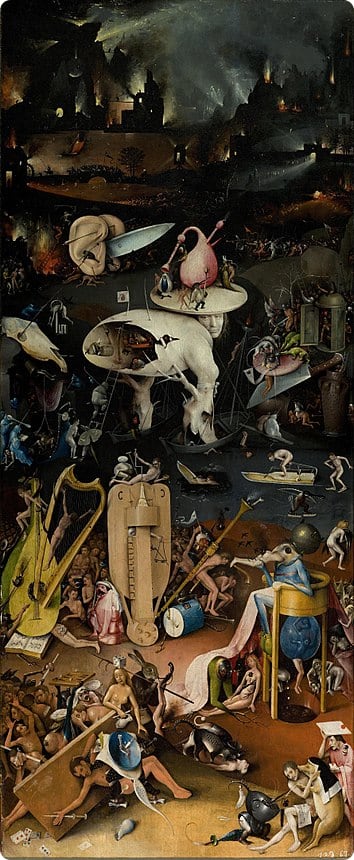
The nightmarish scenes that surround the central figure, where gluttony and greed find their bizarre punishments, reflect the inner corruption and the inherent imperfection of humanity. Musical instruments, once sources of joy in the central panel, are now contorted into tools of torture, illustrating Lacan's notion that desire is insatiable, leading not to fulfillment but to a cycle of longing and dissatisfaction. The grotesque thus becomes a reflection of the human condition, where the lines between punisher and punished are blurred, and the landscape itself participates in the macabre dance of damnation.
In this hellscape, Bosch intentionally omits the life-giving water that was central to the earlier panels, a stark symbol of the spiritual desolation that follows a life surrendered to base indulgence. The absence of water here is not merely a physical void but a visual representation of a total spiritual drought. It parallels the absence of redemption and grace, emphasizing the irreversible consequences of the souls' indulgences. The water's absence echoes the psychological fragmentation depicted by the central figure, representing a longing for a wholeness that is forever elusive. The once fluid and liberating desires, symbolized by water in Eden and the central panel, have led here to a desiccated reality where fulfillment and satisfaction remain unattainable.
Bosch uses this absence to underscore the final synthesis of our inherent flaws; our unchecked hedonism has led us to a cruel fate marked by an unfulfilled existence and a fragmentation of self that has become our true identity. The detailed brushwork and visualizations in the final panel compel the viewer to see sin not as an external force but as an intrinsic part of the human condition, woven into the fabric of this hellscape as surely as they were into the fabric of creation. Bosch's depiction of Hell, devoid of the cleansing and redeeming waters of life, serves as a surreal mirror to the folly of human nature. It is a world where the grotesque is normalized, and the absurdity of human desires is laid bare. His work critiques the cyclical nature of sin and challenges viewers to reconsider traditional moral perspectives, foreshadowing psychological explorations into the complexities of existence and the profound impact of our constructed self-images and our failures to reconcile them.
In synthesizing the thematic threads woven throughout "The Garden of Earthly Delights," Bosch's triptych emerges as a profound and subversive exploration of human experience. The left panel subtly prefigures the narrative of indulgence that unfolds across the work, with its otherworldly Eden setting the stage for the complexities of desire and morality. The central panel's depiction of unbridled pleasure, devoid of traditional religious iconography, challenges viewers to consider the nature of sin and virtue outside the strictures of ecclesiastical authority. The right panel's hellscape, a surreal tableau of retribution, reflects the consequences of unchecked indulgence and the psychological fragmentation that can arise from our deepest yearnings. Bosch's artistry critiques the cyclical nature of human folly, positioning sin and imperfection as inextricable from our existence, while simultaneously foreshadowing modern psychological explorations of the unconscious and the constructed self. This triptych, in its entirety, serves not only as a visual narrative but as an intricate allegory that prompts a reevaluation of traditional moral perspectives and the human inclination towards excess and desire. Bosch's "The Garden of Earthly Delights" stands as a testament to the enduring quest to understand the enigma of the human condition, resonating with contemporary audiences as much as it did with those of his own time.
Works Cited
- Bosch, Hieronymus. The Garden of Earthly Delights. 1480-1505.