Arch of Constantine
Fall 2022
The Arch of Constantine, constructed in the heart of Rome between 312-315 AD, stands as a pivotal monument marking a transition in architectural design, urban planning, and imperial ideology during the turbulent 4th century. Through its innovative combination of spoliated and newly carved decorative features, strategic siting, and allusions to the adjacent Colossus of Sol, the arch exemplifies the complex negotiations between pagan and Christian, classical and medieval influences that characterized Constantine's reign. An in-depth analysis of the arch's design, ornamentation, and topographical context within the Colosseum Valley reveals how Constantine appropriated the urban fabric of Rome to construct a new narrative of legitimacy and triumph in the wake of civil war.

At 69 feet tall, 85 feet wide and 24 feet deep, the Arch of Constantine is the largest surviving Roman triumphal arch. Constructed of brick-faced concrete covered in marble, it consists of a large central passageway flanked by two smaller ones, with detached columns on high pedestals framing each opening. This triple-bay design with prominent columns was modeled on the earlier Arch of Septimius Severus in the Roman Forum.
However, the Arch of Constantine displays a striking eclecticism in its ornamentation, freely mixing reused sculptures from 2nd century monuments with newly carved friezes and reliefs. The spoliated roundels and panels, depicting sacrifice and hunting scenes, clash in both style and theme with the more static, frontal Constantinian friezes showing the emperor's military victories. This jarring juxtaposition of classicizing and late antique elements signals a deliberate rupture with Rome's imperial past. By co-opting imagery from "good emperors" like Trajan and Hadrian while proclaiming his own achievements, Constantine appropriates their esteemed legacy to bolster his own nascent dynasty.
Beyond stylistic bricolage, the unusual orientation of the arch also reflects Constantine's shrewd manipulation of the urban landscape. Set back from the ancient triumphal parade route, the arch is skewed to align with the colossal bronze statue of Sol (originally of Nero) that stood atop a tall brick podium facing the Colosseum. From certain angles, the colossus appears perfectly framed by the arch's central passageway, an illusion of axial alignment that visually links Constantine to the solar deity. This topographical association, reinforced by images of Sol on the arch itself, publicizes Constantine's special relationship with his patron god while avoiding overt references to Christ that might offend conservative Romans.
The layered meanings embedded in the Arch of Constantine reflect the complex and contradictory forces that shaped the emperor's 31-year reign as he steered the Roman Empire towards Christianity. Having defeated his rival Maxentius at the Battle of Milvian Bridge in 312, allegedly with the help of Christ, Constantine needed to establish his legitimacy in Rome without alienating the still largely pagan Senate and populace.
An ambitious building campaign provided the ideal means to garner popular support while promoting Constantine's own brand of syncretic monotheism, blending worship of Sol Invictus with Christian symbolism. By recutting Maxentius' imperial monuments and erecting his triumphal arch at a key node between the Palatine, Caelian and Esquiline Hills, Constantine literally reshaped the ancient capital in his own image. The Colosseum Valley in particular, site of Nero's notorious Domus Aurea, became a sort of Constantinian forum, unified by sightlines to the Colossus of Sol and other solar-themed structures like the Circus Maximus.
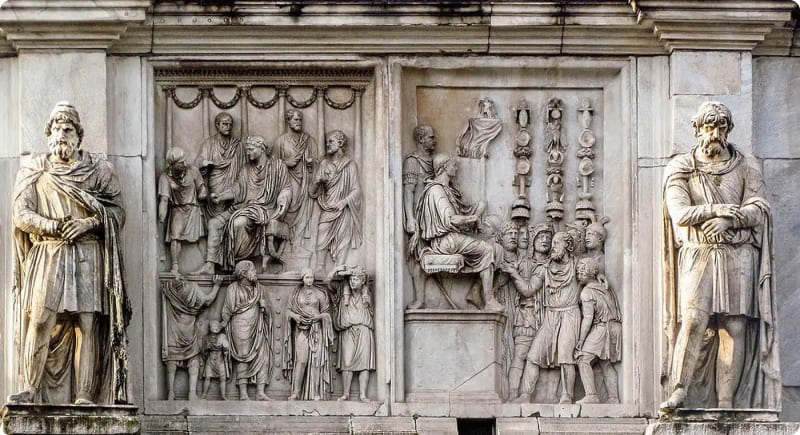
At the same time, the arch's inscription attributing Constantine's victory to the "inspiration of divinity" (instinctu divinitatis) ingeniously appealed to both pagan and Christian readings. Even as he courted the Roman establishment with the arch's classicizing elements, Constantine was already building churches and embracing Christian rites like Sunday worship. His canny management of his public image thus paved the way for the eventual Christianization of the empire, even as he maintained pagan titles like pontifex maximus.

The Arch of Constantine's unique synthesis of classicism and abstraction, as well as its subordination of sculpture to a dominant architectural framework, inspired both medieval church architecture and Renaissance civic monuments. The stylized, almost iconic figures in the Constantinian frieze find echoes in early Christian and Byzantine mosaics, while the use of spoliated reliefs as a form of political propaganda recurs in Carolingian and Ottonian structures. Above all, the arch's towering attic, debased columns and overwhelming frontality herald the flattened, starkly symmetrical facades of Romanesque cathedrals.
In 15th century Italy, the arch's reputation as a transitional monument made it a key reference point for architects seeking a revival of classical forms. Filippo Brunelleschi imitated its nested columnar orders in the Ospedale degli Innocenti, and Leon Battista Alberti emulated its rustication and use of white marble in the Palazzo Rucellai. By selectively reviving elements of the Arch of Constantine in their revolutionary designs, Renaissance masters positioned themselves as inheritors of the imperial Roman legacy, much as Constantine himself had done.
Through its formal experimentation, urban contextualism and canny political subtext, the Arch of Constantine encapsulates the transformations in art, architecture and ideology during the twilight of pagan Rome. By fusing classicizing and abstract elements, manipulating sightlines to older monuments, and alluding to both Christianity and solar cult, Constantine created a structure that embodies the cultural hybridity and contradictions of its era. In its deft balancing of tradition and innovation, the arch became a model for later rulers and architects seeking to appropriate the prestige of the classical world for their own ends. As such, it not only illuminates a pivotal moment in the Christianization of the Roman Empire, but also the complex processes of transmission and revival that shaped the development of Western architecture through the Middle Ages and beyond.
Works Cited
- Ingersoll, Richard. World Architecture: A Cross-Cultural History. Oxford University Press, 2020.
- Marlowe, E. (2006). Framing the sun: The arch of Constantine and the Roman cityscape. The Art Bulletin, 88(2), 223-242.