The Aqueduct of Segovia
Fall 2022
Among the myriad architectural marvels of the Roman Empire, the Aqueduct of Segovia stands as a monumental testament to the remarkable engineering skill, utilitarian focus, and expansive vision that characterized Roman construction at its zenith (Turespña, 2006). While the Colosseum in Rome symbolically represents the pinnacle of Roman entertainment architecture and the Pantheon exemplifies the empire's mastery of large-scale concrete construction, the Aqueduct of Segovia embodies the societal impact and practical ambitions of the Romans in a uniquely compelling way. Its enduring presence and seamless integration of form and function make it a powerful symbol of Roman hydraulic engineering and a tribute to the empire's lasting influence on the Iberian Peninsula.

The exact date of the aqueduct's construction has been a subject of scholarly debate due to the absence of a definitive dedicatory inscription. Most scholars agree it was built during the 1st century AD, likely under the Flavian emperors, particularly Domitian (r. AD 81-96) (Alföldy, n.d.). However, the earliest concrete evidence of the aqueduct's existence comes from the reign of Trajan (r. AD 98-117), whose name is invoked in a fragmentary inscription that once adorned the attic of the aqueduct's iconic arcade where it reaches its maximum height in the Plaza del Azoguejo (UNESCO, n.d.).
In 1992, Hungarian archaeologist Géza Alföldy deciphered the partial inscription by studying the holes that once held the bronze letters in place. His interpretation suggests that Trajan ordered a major restoration of the aqueduct in the early 2nd century AD:
"By order of Emperor Nerva Trajan Caesar Augustus, Pontifex Maximus, holder of the tribunician power for the second time, consul for the second time, father of the country, Publius Mummius Mummianus and Publius Fabius Taurus, co-magistrates of the Flavian municipality of the Segovians, restored the aqueduct."
Given the integral role of the attic within the aqueduct's design, it's possible Trajan's "restoration" may have entailed completing an unfinished structure or substantially rebuilding an existing one, rather than simply repairing it. This hypothesis gains support from the discovery of a sestertius coin from Trajan's reign, along with abundant Roman pottery, in the foundations of the aqueduct's easternmost arches (Martín, 2016).
While the aqueduct's construction is concretely tied to the height of imperial Rome, the origins of Segovia itself are less clear. Located at the confluence of the Eresma and Clamores rivers, the settlement was inhabited by the Arevaci, a Celtiberian people, before falling under Roman control as the empire expanded across the Iberian Peninsula from the 2nd century BC onward. Segovia's position along the important Roman road between Emerita Augusta (Mérida) and Caesaraugusta (Zaragoza) spurred its growth, though it never rivaled those major cities in size or stature. Nevertheless, Segovia was significant enough to warrant the construction of the monumental aqueduct to supply its populace with fresh water from the distant Frío River.

Stretching approximately 15 km from the Sierra de Guadarrama to the heart of Segovia, the aqueduct is a marvel of Roman hydraulic engineering. Only a small fraction of the conduit—the iconic arcade bridging a deep valley at the Plaza del Azoguejo—is visible above ground. This section, reaching a maximum height of 28.5 meters and spanning over 800 meters with its 166 arches, is among the best-preserved Roman aqueduct bridges in existence (UNESCO, n.d.).
The aqueduct was constructed using an estimated 20,000 granite blocks, precisely cut and assembled without mortar (Turespña, 2006). The arcade features two tiers of arches: while the lower level has taller and wider pillars, the upper level's pillars are shorter and narrower, gracefully reducing the structure's visual weight as it rises. Water flowed through a U-shaped channel atop the arcade, 0.55m deep by 0.46m wide. The entire structure rests on a foundation extending 6m underground.
The aqueduct's design epitomizes the principles espoused by Vitruvius, the 1st-century BC Roman architect and engineer. Its remarkable durability and structural resilience exemplify firmitas (strength); its original purpose as Segovia's primary water source embodies utilitas (functionality); and its striking, minimalist beauty evokes venustas (aesthetic appeal). The graceful repetition of geometric forms and the dramatic scaling of its arches create an exhilarating visual rhythm, enhanced by the unconventional use of granite rather than the more typical Roman brick or marble.
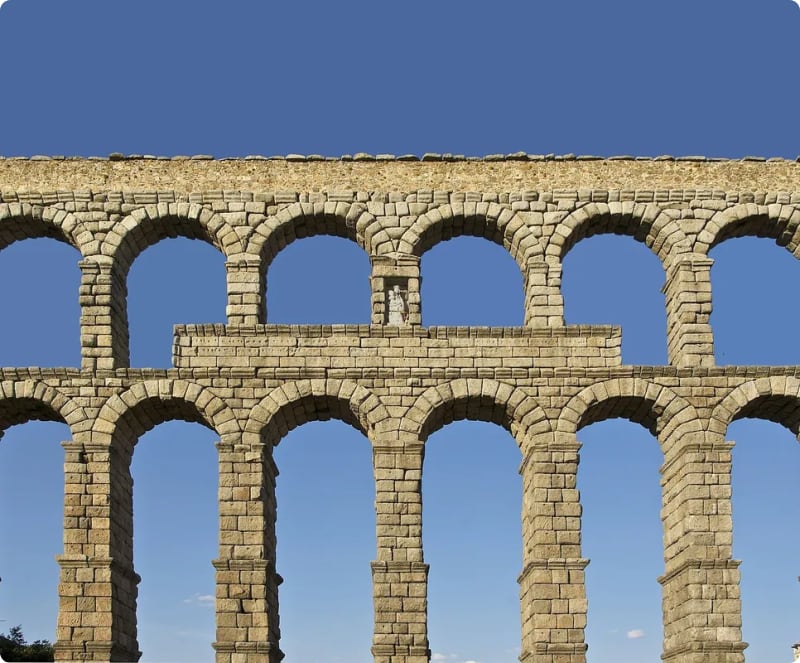
Complementing its virtuosic engineering, the aqueduct's design subtly responds to its rugged, undulating setting. The conduit's course was carefully planned to maintain the necessary gradient for water flow, gently bending and shifting in elevation to navigate the terrain between the Frío River and Segovia (Turespña, 2006). Within the city itself, the water supplied bathhouses, public fountains, private residences and, in later centuries, the Alcázar fortress, through an underground network of lead pipes ("El acueducto soterrado," 2018).
The Aqueduct of Segovia is remarkable not only for its age and excellent state of preservation but for its outstanding functionality over nearly two millennia. Segovians continued to drink from the aqueduct's waters until the mid-20th century. This unparalleled longevity also posed challenges, as the structure underwent multiple phases of rebuilding and repair from the 11th century onward.
In the late 15th century, under Queen Isabella I of Castile, the first 36 arches damaged during conflicts with the Moors were reconstructed, the slightly pointed shape of the new arches subtly contrasting with the purely rounded original ones (Vučković, 2019). Subsequent repairs in the 16th-18th centuries aimed to maintain the aqueduct's functionality and structural integrity. However, by the mid-20th century, the monument faced serious threats from encroaching development, automobile traffic, and air pollution (Norma Barbacci, 2007).
A major restoration campaign from 1970-1974 addressed some of these issues but proved controversial in its heavy-handed approach. Another intensive intervention in the early 1990s, while banning vehicular traffic under the arches, introduced new problems through the use of resins and other non-traditional materials. Inadequate protection of the aqueduct's subterranean portions was underscored when construction of a high-speed rail line in 2000-2001 damaged a 14-meter section between Segovia and the Sierra de Guadarrama.
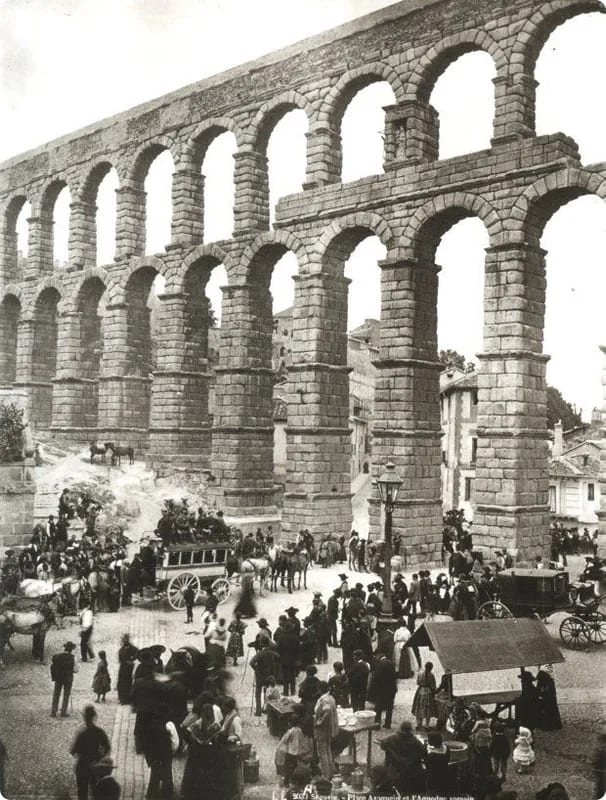
In response to these threats, the aqueduct was included on the World Monuments Watch List in 2006. This listing galvanized authorities to re-examine the monument's conservation needs and develop a comprehensive management plan. Detailed studies were undertaken to map the deterioration of individual granite blocks and assess the broader landscape of the aqueduct's 17-km route (Norma Barbacci, 2007). These efforts laid the groundwork for a more holistic, interdisciplinary approach to preserving the aqueduct and its wider environment.
The Aqueduct of Segovia endures as a monumental expression of Roman technical prowess, imperial reach, and concern for public welfare. Its fusion of engineering brilliance and aesthetic refinement, its seamless rapport with a dramatic terrain, and its remarkable persistence over twenty centuries distinguish it among the Roman Empire's most imposing and culturally resonant achievements.
Recent research and conservation initiatives have highlighted the aqueduct's vast untapped potential—not merely as an isolated monument, but as the unifying spine of a rich and varied landscape shaped by geology, history, and human enterprise. With diligent stewardship informed by a landscape-scale sensibility, the aqueduct can transcend its functional obsolescence to find new life as a cultural catalyst, reframing Segovia's relationship to its regional context and to its Roman past (Norma Barbacci, 2007). In this light, the Aqueduct of Segovia emerges as a powerful lens through which to contemplate time, civilization, and humanity's complex dialogue with the natural world. Its legacy is a challenge to reimagine ancient infrastructure as the armature for resilient, culturally vibrant contemporary cities.
As it approaches its third millennium, the aqueduct invites us to ponder anew what the UNESCO World Heritage Convention calls "the combined works of nature and of man"—and to discover within its monumental fabric both an irreplaceable record of human history and an inspiring template for habitats that gracefully bridge the constructed and natural realms, the pragmatic and poetic, the prosaic present and the depths of time (UNESCO, n.d.).
Works Cited
- Ingersoll, Richard. World Architecture: A Cross-Cultural History. Oxford University Press, 2020.
- Alföldy, G. (n.d.). Die Inschrift des Aquäduktes von Segovia.
- El acueducto soterrado. (2018).
- Martín, A. (2016, October 31). El hallazgo de un sestercio cambia la edad del acueducto de Segovia. El País.
- Norma Barbacci. (2007). Saving Segovia's aqueduct. ICON Magazine, Winter 2006/2007, 38-41.
- Turespña. (2006, January 31). The Segovia aqueduct in Spain.
- UNESCO. (n.d.). Old town of Segovia and its aqueduct.
- Vučković, A. (2019, July 29). The lifegiving aqueduct of Segovia, a glorious Roman heritage. Ancient Origins.