Sur-réalisme
Fall 2022
Guillaume Apollinaire was a pivotal visionary in the orchestration of the early 20th century Parisian art scene, a crowd frequented by the likes of Pablo Picasso and Marcel Duchamp. An emphatic defender of the progressive Cubism movement and the originator of “Surrealism” as an artistic term, Apollinaire’s commitment to literary conformity established him as a pioneer of an entirely fresh cultural spirit. Such avant-garde sympathies were not easily deflated by the eruption of the Great War and Apollinaire, a man well past the conscription age, willingly plunged himself into the depths of the world’s first modern conflict. It’s here in the chaotic midst of the Western front that Apollinaire writes the poem “Wonder of War”; an expressive soliloquy of an individual’s wartime dissociation and disordered societal prognosis that defined the First World War and incipient Modernism.
Guillaume Apollinaire volunteered to serve with the 38th Regiment of Field Artillery at the outbreak of World War 1 in 1914. A substantial cohort of Western writers would be categorized as the “Lost Generation” due to intense disillusionment experience during the war’s rapid mobilization and mass casualties. However, Apollinaire’s spirited experimentalism materialized as a literary ambition in capturing the gory spectacles unleashed by the world’s first modern war. It’s on the front lines where carnage becomes a canvas for Apollinaire as he absorbs conditions of critically non-traditional warfare in an equally unorthodox way.
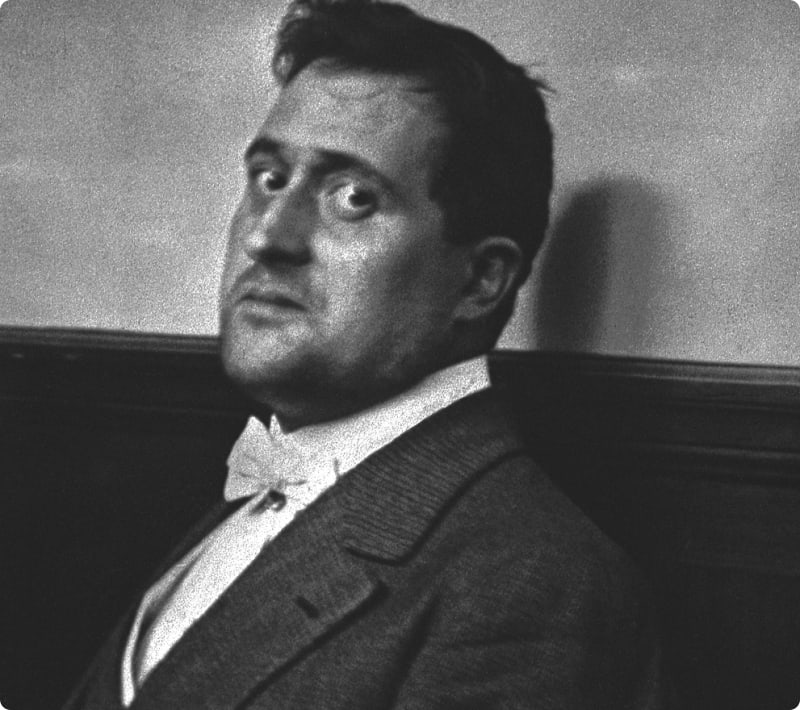
Between 1914 and 1916, Apollinaire assembled Calligrammes, an innovative collection of poems that offer a glimpse into the spiritual intoxication ushered in by the complete physical and figurative collapse of conventions embroiling the front lines. In Apollinaire’s “Wonder of War”, he presents a report where the subjective elements dominate as traditional Realist objectivity fails to capture the war’s shock and confusion. He begins the poem by infusing his accounts of detached military paraphernalia with the precarious eroticism of a love affair.
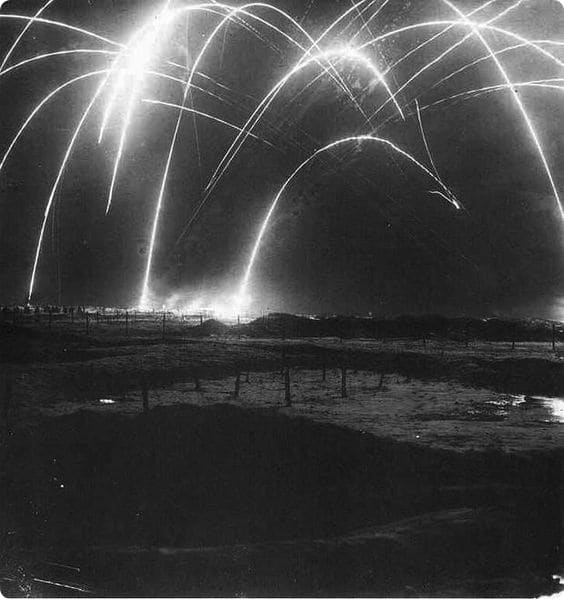
“How lovely these flares are that light up the dark
They climb their own peak and lean down to look
They are dancing ladies whose glances become eyes arms and hearts
I recognize your smile and your vivacity” (Apollinaire 1-4)
From the very first stanza, war is characterized as a “lovely” pyrotechnic spectacle as Apollinaire relates the flares that direct nighttime attacks to “dancing ladies whose glances become eyes, arms, and hearts.” His use of excessively provocative imagery when opening a wartime anecdote is not simply a fetishized chauvinism, but rather it is Apollinaire’s poetically realized fantasy of desire that detaches from the surrounding horror. In truth, the “dancing ladies” are merely flares whose glow will soon illuminate another swath of individuals doomed to be slaughtered by a barrage of artillery. A fusion between the erotic beauty of the feminine and the incendiary beauty of the flares, the lines are blurred between desire and bewilderment as the source of Apollinaire’s enthusiastic astonishment.
Furthermore, in the subsequent stanza Apollinaire depicts the daily deliverance of the flares as his “Berenices”, a Greek name meaning ‘bearer of victory’ – like a flare as an instrument of advancement in war. The “comets” (flares) are at their “apotheosis”, or climax, implying they will soon be followed by shrapnel and loss. The deliberate cosmic imagery in the targeting and firing of artillery brings the mechanically removed bloodshed of the Great War into a more universal context denoting the brevity of human life.

“It's also the daily apotheosis of all my Berenices whose hair has turned to comets' tails
These dancing girls twice gilded belong to all times and all races
Swiftly they give birth to children who have just time enough to die” (Apollinaire 5-8)
Due to such unrelenting inhumanity, he still remains in his protective fantasy and he articulates that the “dancing girls” are “twice gilded” as they need increasing veils of deceit in order to hide the glaring truths of warfare. These “girls” are then depicted maternally as their light births shadowy figures into full visibility, soberly equating cowering soldiers to helpless “children” at the whim of the incomprehensible.
The third and fourth stanza make apparent Apollinaire’s increasingly unstable psyche as he requires his fantasy to multiply as “it would be finer if there were still more of them.” The more hedonistic the delusion, the more total the war.
“How lovely all these flares are
But it would be finer if there were still more of them
If there were millions with a full and relative meaning like letters in a book
However it's as lovely as if life itself issued from those who are dying…” (Apollinaire 9-12)

Warfare is then transported into his irrational literary world in his representation of the chaos of combat as a book with the flares constituting its letters. Thus, only when certainty and transparency are unrestricted, and not simply struck by a brief shimmering malice, can the apprehensive book of war be relatively understood.
Apollinaire is faltering in his psychical transmutation as he now regards the loveliness of his fantasy to be representative of “life itself” extinguishing.
“…But it would be finer still if there were still more of them
And yet I see them as a beauty who offers herself and immediately swoons away” (Apollinaire 13-14)
Here, Apollinaire calls for the profusion, the intensification, the explosion, and the expansion of the war’s impalpable phenomena and awesome sensations. Not out of an anarchist streak, but simply for an equal increase in their soothing delusions. Nevertheless, desire is proven to both empassion and embitter as the pyrotechnic sexuality of the flares “immediately swoons away”.
The lustful symbolism of the flares is discarded by Apollinaire as he scrambles to find another magical, metaphorical shield. Thus, his transition into the 5th stanza is marked by an affirmative delivery where the treacherous desire of an erotic affair is now a “great feast lighted a giorno”; a wartime bachanal that rejects the nocturnal terror in exchange for the aesthetic daylight of a painting “a giorno.”
“I seem to be at a great feast lighted a giorno
A banquet that earth offers herself
Hungrily she opens her long pale mouths
Earth is hungry and here is the feast of this cannibal Balthazar” (Apollinaire 15-18)
However, Apollinaire’s metaphor of the merry feast is quick to fail as his personified Earth is lost in a disillusioning gluttony. “Her long pale mouths” are the extensive trench networks that scar her surface, and they remain in constant cannibalistic consumption. The soldiers’ familiar earthen homes then become their shallow foreign graves. The feast is conclusively realized as belonging to a “cannibal Balthazar”, a biblical magi whose gift of myrrh to Jesus symbolizes a sacrificial death. Therefore, those who join the feast are shown by Apollinaire as bound for a paradoxical unraveling. The soldiers are forced participants of the “feast”; a war which casts them into a physical and spiritual extermination before their sacrilegious consumption by cannibalism.
The bastardized analogy of the feast continues into the sixth stanza, where Earth’s cannibalism has disseminated into the air. The pervasive smell of charred friends and compatriots is like that of an “empyreumatic” fine wine as Apollinaire’s escapism is overpowered by his elements. This delusional wonder is replaced with a cynical awe as the Earth’s “anthropophagous” maximalism allies with the sky; the voracious Earth swallows the roasted bodies, and the heaven swallows up their souls.
“Who would have said one could be so anthropophagous
Or that so much fire was needed to roast human flesh
That's why the air has a slight empyreumatic taste which by God is not
unpleasant
But the feast would be finer still if the sky too dined with the earth
But it swallows only souls
Which is a way of not nourishing oneself at all
And it's content to juggle with multicolored lights” (Apollinaire 19-26)
Apollinaire's wartime mystification is now confidently separate from any alienation. His ironically polite despair transitions into a grim acknowledgement that his festive fantasy is complete only “if the sky too dined with the earth.” The sky swallows emptiness, the flares, the “multicolored lights”, the souls; but not the bodies, the experience, the death, the intoxicating fury of the moment.

Apollinaire’s soliloquy still yearns to reach the sky’s restrictive elevation and ethereal escape, but the 7th stanza delineates his inevitable resignation to war’s destruction of individuality as he further associates with the Great War’s otherworldly horrors. Horrors that confirm an individual can never truly remain at war without the unconditional loss of self. Apollinaire’s “flow” state is simply the decomposition of his identity as he no longer exists outside of his company. It is now only instances of “a few cries of flame” that confirm his biological existence.
“But I have flowed into the sweetness of this war
with my whole company along the long trenches
A few cries of flame keep announcing my presence
I have hollowed out the bed where I flow and branch into a thousand small
streams going everywhere
I am in the front-line trenches and still I am everywhere or rather
I am beginning to be everywhere…” (Apollinaire 27-33)
Apollinaire’s individual devolution is a total fragmentation of reality and being. It’s a restructuring of self that extends from the collapse of a singular Guillaume Apollinaire and into the recomposition of his identity as a ubiquitous entity. Apollinaire’s writing of himself as “everywhere or rather … beginning to be everywhere” plays on his Futurist sympathies as he knows modern warfare’s violent extremity is now a perpetual universality.
“...For it is I who begin this affair of the centuries to come
It will be longer to realize than the myth of soaring Icarus” (Apollinaire 34-35)
However, Apollinaire finds his developing ubiquity to similarly be an indomitable “affair” that has only just commenced with the savagery of The Great War, and which will now flow unrestricted into “centuries to come.” Apollinaire’s individual dissolution is now the source of a universal literary diffusion; his proto-surrealist prose and shared experience of total dehumanization has culminated into a poetic declaration of his forced role in the dawn of a new type of warfare. His omnipresence puts forth a literary donation, a cautionary tale, to future generations. Yet, this is still intertwined with cautious skepticism as Apollinaire posits such cultural aspirations “will be longer to realize than the myth of soaring Icarus.”
In the 8th stanza of “Wonder of War”, Apollinaire makes a cosmic testament to his past poetic exploits through his opening declaration to “bequeath to the future the story of Guillaume Apollinaire.” His existence is relayed through an identification with his own poem, as he strives to unite the past, the present and the future through a captured literary legacy.
“I bequeath to the future the story of Guillaume Apollinaire
Who was in the war and knew how to be everywhere
In the lucky towns behind the front lines
In all the rest of the universe
In those who died tangled in the barbed wire
In women in cannons in horses
At the zenith at the nadir at the four cardinal points
And in the unique ardor of this eve of battle” (Apollinaire 36-43)
It is here “at the four cardinal points” where Apollinaire’s voice becomes its most assured and where his dissipated wonder returns through “the unique ardor of this eve of battle.” Apollinaire discretely establishes a temporal connectivity through his movement from a retrospective “I knew how to be everywhere” to a present being “in the unique ardor of this eve to battle.” Thus, Apollinaire’s poetic enunciation unfolds at the moment of battle; a moment when one’s life is faced outright with the gravity of imminent death; a moment when ardor is frenzied and fiery, melting together an individual’s fear, courage, and beauty. His form as an animator of the universe is once again condemned to be bound inside an individual poet at such a pivotal point in history.
The 8th stanza concludes the poem with a decrescendo that indicates Apollinaire’s desire to center himself in a more enduring and determined way as he reverses the terms of his original defensive fantasies.
“And of course it would be finer
If I could imagine that all these things in which I dwell
Invaded me too
But in this sense there's nothing doing
For if I am everywhere at this hour there is only myself who is in me” (Apollinaire 44-48)
Plucked from his transcendentalist state, Apollinaire is now back in the trenches, surrounded by soldiers living on suspended lives. He introspectively reflects that if he is “everywhere at this hour” then there “is only myself who is in me.” Apollinaire is realizing the necessary fight to incorporate the absolute present of the moment into his poetry is a fight to be undertaken in the apprehension and emotional recoil of his own reality. He is here, and his ambition to account for modern warfare’s ferocity is an ambition to unconditionally record the real by naming it.
Guillaume Apollinaire does not disconnectedly see the superficial “beauties” of war, but rather he represents the war in the very same wondrous awe in which he experienced it. His poetry takes the role of a journalist while maintaining his purpose as a modernist and as a man: to find beauty, to experience the human magnitude of desire and suffering – the vigor and illogical intensity of life transmuted into an enduring cultural artifact. Such an intimate poetic experience is as earnest as the anguish of those never able to express it. Through Apollinaire’s vocalized report of turbulent introspection, through his proclamations as a ubiquitous presence and universal force, and through his wartime confrontation with singularity, the poet establishes himself as the Modernist spokesperson and forces a remembrance of the otherwise forgotten.
Works Cited
- Apollinaire, Guillaume. “Merveille De La Guerre.” Calligrammes; Poèmes De La Paix Et De La Guerre, 1913-1916, pp. 257–259.