America’s Longest War
Fall 2021
The War on Drugs is an ongoing political and economic feud that has been waged heavily in America since as early as the 1930s. It gained its true steam in the later 20th century due to the fallout of narcotic use in the Vietnamese war and the Reagan family’s public “Just Say No” sit down with the American people in the 1980s. The majority of my adolescence was spent in West Virginia, which could be regarded as almost Ground Zero of the modern opioid crisis. I’ve seen firsthand the devastation that unchecked addiction and access to substances can cause on families and communities. From these experiences, it’s evident that an approach of strict legislation and harsh punishment seen in The War on Drugs only serves to further entrench the existing issue. The War is not perpetually waged against drugs for the benefit of the population, but rather it’s a war on the American masses by capitalists and morally corrupt politicians. Furthermore, the efforts of mass incarceration and severe law and order implemented with the aid of influence and direct meddling by these groups must shift towards a welfare and rehabilitation oriented approach to best benefit the American public.
Ronald Reagan’s War on Drugs is still ongoing in 2021, and is highlighted by an overly-aggressive and racial approach to the American drug epidemic. Beginning in the 1980s, minority groups saw a domination of crack in their communities, while white communities saw the domination of powdered cocaine. In relation to this, a government study found that the war on drugs contains an 18:1 sentencing disparity of crack compared to powdered cocaine. In addition, while crack cocaine and powdered cocaine are virtually the same substance, the sentences brought against crack offenders are much heftier than those found in possession of powdered cocaine (Palamar). The sentencing disparity shines light on the issue of state or federal agencies unequally targeting and punishing lower-income and ethnically diverse communities. Furthermore, The War finds a synergy with the private U.S. economy as well, as nonviolent drug offenders find themselves behind bars in private prisons. Private prisons themselves are another symptom of a misaligned justice system, as they directly secure profits through large inmate populations and bare-minimum expenses in regards to their quality of life. According to the Bureau of Justice Statistics, in 2004, 25.3% of prisoners in private prisons were arrested on drug offenses, which is 7% more than even violent offenders. Drug offenses are consistently over enforced and met with extreme punishment in order to keep bodies inside prison cells and to keep profits consistent for those in the private sector.
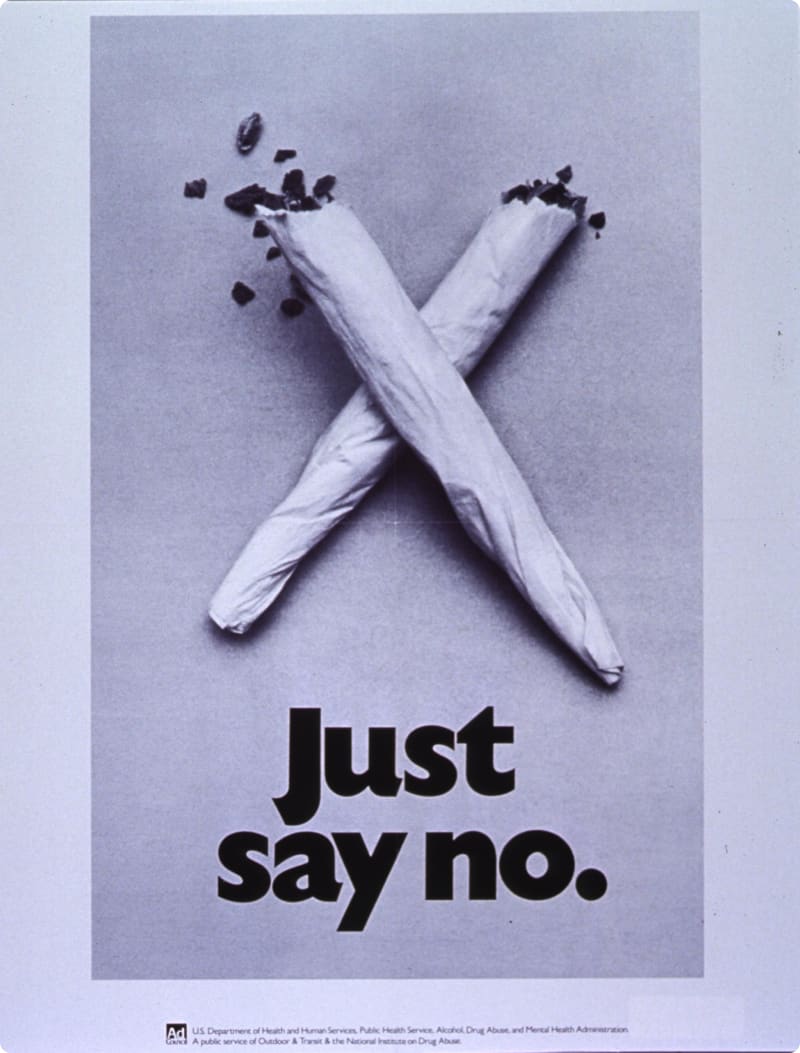
The rhetoric behind this fight aims to demonize drug users by using blatant hyperbole in reference to substance abuse. Anti-drug media campaigns constantly use terrifying mugshots to scare the masses, while the federally funded DARE and other campaigns flood schools with misinformation about the true effects of drugs in flagrant attempts to spread fear mongering amongst undeveloped minds. For example, DARE constantly spreads the rhetoric that after “just one hit”, an individual will be hopelessly hooked on a substance. However, according to the National Institute of Drug Abuse, only 23% of first time users of heroin eventually became addicted. Heroin is extremely addictive, and 23% is a sizable number, but it's not what’s being taught in preventative courses. Another example of misinformation can be seen on the DEA Scheduling List, where Marijuana is referred to as a “Class 1 Drug” that has a high chance for addiction and no medical or research benefits (DEA). Yet, marijuana is legal for medicinal use in 36 states and is used to treat symptoms associated with cancer and glaucoma. In fact, marijuana has proved to be an efficient pain reliever, as “a majority (65%) of patients also reported either a reduction or total discontinuation of at least one prescription or over-the-counter drug” (Rosental and Pipitone). Not only has marijuana proved to be an efficacious medicine, but it also plays a central role in guiding people away from the more predatory class of opiates. Despite marijuana actively playing a role in diminishing the opioid crisis, it is still categorized as being equivalent to heroin.
Marijuana’s demonization didn’t start under Reagan’s administration, but began in the 1930s. However, not unlike Reagan’s efforts, legislation against marijuana was rallied by political and economic motives, and not inspired by a realistic concern for the American population. Legislation against marijuana was lobbied by the likes of Randolph Hearst and the DuPont family, who saw a byproduct of marijuana (hemp), as an imminent danger to the lumber and paper industries that, at the time, their firms held dominant interest in. This is not a unique experience, as today marijuana is lobbied against by major pharmaceutical companies due to it being a safe and cheap alternative to their more expensive and addictive products. At the same time, the Great Depression took hold of the American economy and labor markets, which led to job shortages and subsequent social chaos. Racially inflammatory rhetoric pushed the blame on immigrants, namely the large Mexican population on the West Coast, and despite mass deportations, they were still seen as a perceived threat. However, Mexican-Americans and Mexican immigrants were also larger users of marijuana, and similar to the crack epidemic of the 1980s, laws were put into place to curb the growing “zoot suiters” and keep Mexican’s on a lower socio-economic platform (Shultz and Aspe).

In 2021 there has been little to no genuine reform in regards to these antiquated “preventative” measures. The federal government has been in constant deadlock in regards to the legality of even marijuana and there’s little auspicious reasoning that shows meaningful nation-wide legislation will be passed in the future. However, state and municipal governments have begun to take the reins and give clarity to a previously shrouded issue. In the past presidential election, Oregon voted to decriminalize all drugs in a bold progressive stance. This means while any controlled substance is still a crime, a perpetrator will only face a fine or a ticket for any drug related discretion. This is a gigantic step forward in regards to a view on drugs in America. Past and present, drug users have been punished intensely for meager possession violations, and this leads to a felony record. A felony record is incredibly detrimental in the search for meaningful employment, as well as in terms of societal opinion. A lack of true occupation and imminent social rejection, spurred by the aforementioned propaganda campaigns, just serves to intensify a repeating cycle of drug use and crime in offenders, causing increased reincarceration rates. In fact, 82.5% of total drug arrests in 2007 were for personal possession, which shows that mass incarceration efforts disproportionately affect the victims of substance abuse, and not those who genuinely perpetuate the crisis through the sale or manufacturing of illicit substances (Bureau of Justice Statistics).
Furthermore, decriminalization shows a positive shift of public opinion regarding drug usage. It’s gradually being seen as a public health issue, and not an issue of law and order. Drug users should be seen as victims, and in need of rehabilitation, not as criminals who end up serving the same adverse prison terms as violent offenders. In place of arbitrary incarceration, clean needle stations, rehabilitation centers, and other social welfare programs should be extended to those in need. In Oregon, the legislation passed also included “the expansion of access to recovery treatments, housing, and harm reduction services, to be funded through the reallocation of tens of millions of dollars from Oregon’s cannabis tax” (Lennard). These social welfare programs already had the necessary funding due to the previous legalizing of marijuana, which is symbolic of how a varied approach can produce beneficial economic effects in the long run. Decriminalization is a step forward for Oregon in terms of the cyclical nature between criminal records and drug use, but these efforts should keep momentum and hopefully lead to new implementations of health care programs. Unfortunately, as long as private prisons and deep rooted racial fears exist in America, little policy change will be seen federally in efforts to curb the societal damages of the failed War on Drugs.

To deny the efficacy of anti-drug campaigns is not to deny the existence of an addiction issue. There is no doubt that there is an ongoing drug epidemic in the United States. Since 1999, over a quarter million people have died from opioid overdoses alone (U.S. Department of Health and Human Services). Nevertheless, the way to tackle this issue is not through mass incarceration and strict punishments for offenders. Prison does little to rehabilitate victims of drug addiction, and a criminal record is proven to have intensely negative effects on cultural perception and in finding gainful employment. This authoritarian campaign only deepens a dismal cycle that further pushes addicts into exploring nefarious means as a way to make money or to cope with their environment. If the government showed true concern, they would take a broader Portugal-esque approach, where they decriminalize drugs and treat addicts instead of imprisoning them and further deteriorating their quality of life. Susanna Ferreira’s article “Portugal's Radical Drugs Policy Is Working. Why Hasn't the World Copied It?” shows the astounding extent in which this more rational approach curtailed drug addiction, drug related illnesses, and deaths. In fact, “HIV infection plummeted from an all-time high in 2000 of 104.2 new cases per million to 4.2 cases per million in 2015” after the implementation of progressive legislation. In addition, there was also a large cultural impact, because after decriminalization “the language began to shift, too. Those who had been referred to sneeringly as drogados (junkies) – became known more broadly, more sympathetically, and more accurately, as “people who use drugs” or “people with addiction disorders” (Ferreira). While decriminalization ameliorates damage done by the justice system and provides transparent health benefits, it also aids in breaking enduring stigmas and a deplorable cultural perception. America doesn’t need a war, it needs rehabilitation.
In conclusion, The War on Drugs, presently and historically, saw no care for the true health of the American masses, but was rather used as a fear mongering tool by capitalists and politicians to keep their profits steady and white America happy. This approach turns victims of drug addiction into criminals, and keeps money flowing into an illicit black market where it then funds more nefarious and violent crime. Furthermore, the current way of law and order in terms of illicit substances does little to curb the true addiction epidemic, but rather sees victims of drug abuse find themselves in increasingly worse social positions. It’s easy to analyze this issue and to only see statistics, but it’s important to recognize the intense loss and destruction of individual lives and families. I’ve seen what happens when loved ones fall into the vicious cycle, and I’ve experienced all the repugnant reverberations that follow. It seems almost inhuman to categorize this anguish and depreciation of self as merely a data point. Any efforts to curb the drug epidemic in the U.S. need to focus on individual welfare and proper preventative measures, or these tragedies will persist. The federal government needs to expand its sights away from racist motivations and lining pockets and to focus on truly attacking the issue from a social welfare perspective.
Works Cited
- (DCD), Digital Communications Division. “Opioid Crisis Statistics.” HHS.gov, Https://Plus.google.com/+HHS, 12 Feb. 2021, http://www.hhs.gov/opioids/about-the-epidemic/opioid-crisis-statistics/index.html.
- “Drug Scheduling.” DEA, http://www.dea.gov/drug-scheduling.
- “Drug Use and Crime.” Bureau of Justice Statistics, 1 June 2021, https://bjs.ojp.gov/drugs-and-crime-facts/drug-use-and-crime.
- Ferreira, Susana. “Portugal's Radical Drugs Policy Is Working. Why Hasn't the World Copied It?” The Guardian, Guardian News and Media, 5 Dec. 2017, https://www.theguardian.com/news/2017/dec/05/portugals-radical-drugs-policy-is-working-why-hasnt-the-world-copied-it.
- George P. Shultz and Pedro Aspe. “Opinion | the Failed War on Drugs (Published 2018).” The New York Times, The New York Times, 2 Jan. 2018, http://www.nytimes.com/2017/12/31/opinion/failed-war-on-drugs.html.
- Lennard, Natasha. “Oregon's Decriminalization Vote Might Be Biggest Step Yet to Ending War on Drugs.” The Intercept, 4 Nov. 2020, https://theintercept.com/2020/11/04/oregon-drugs-decriminalization/.
- National Institute on Drug Abuse. “Heroin Drug Facts.” National Institute on Drug Abuse, 30 June 2021, https://www.drugabuse.gov/publications/drugfacts/heroin.
- Palamar, Joseph J et al. “Powder cocaine and crack use in the United States: an examination of risk for arrest and socioeconomic disparities in use.” Drug and alcohol dependence vol. 149 (2015): 108-16. doi:10.1016/j.drugalcdep.2015.01.029
- Rosenthal, Martha S., and R. Nathan Pipitone. “Demographics, Perceptions, and Use of Medical Marijuana among Patients in Florida.” Medical Cannabis and Cannabinoids, Karger Publishers, 22 Dec. 2020, https://www.karger.com/Article/FullText/512342#.