Africa’s Economic Allure
Spring 2022
The economic draw of Africa in the late 19th century was rooted in a confluence of factors that colonial powers and related entities were quick to recognize and exploit. The continent's long history of trade networks and its adaptability to external economic relations, which Cooper terms as Africa's "extroversion," provided a foundation upon which European colonizers could build. Rather than starting from scratch, they leveraged these existing networks, reducing their initial investment and increasing efficiency. As Cooper notes, "European colonizers were profiting from and exacerbating an intersection of possibilities and constraints similar to those that underlay the slave trade—African societies' 'extroversion,' their relative resistance to internal exploitation and adaptability to external economic relations" (Africa in the World: Capitalism, Empire, Nation-State).
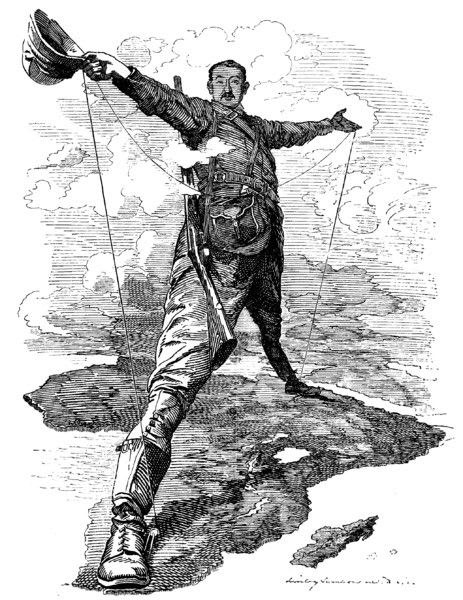
However, it was the discovery of valuable natural resources, such as cocoa in West Africa, that truly ignited the scramble for Africa. Colonial powers and concessionary companies employed brutal methods to extract these resources, including forced labor and oppressive administrative systems. The rubber harvesting in the Belgian Congo stands as a stark example of the lengths to which colonizers would go to maximize profits. As Cooper pointedly observes, "The most exploitative of colonial interventions— the actions of concessionary companies to extract resources like rubber or the forced cultivation of cotton in Portuguese Mozambique, Belgian Congo, or French Equatorial Africa— were notable for their brutality, not their capacity for systematic, long-term development of human and natural resources."
To facilitate the efficient export of these raw materials, colonial governments made selective investments in infrastructure, focusing primarily on "narrow channels of communication, mainly drainage networks to bring goods—African-produced or from mines or settler farms—to ports" (Cooper). These investments were not aimed at broad-based economic development for the benefit of African societies, but rather at maintaining the flow of resources and asserting control over vast colonial territories.
Moreover, colonial powers employed a range of economic and political strategies to maintain their grip on African colonies. These included the imposition of taxes, creation of administrative structures, and manipulation of local elites. As Cooper notes, "Colonial regimes found they had to rely for revenue, labor mobilization, building roads, and many other governmental actions on the very elites of African societies whom they had disparaged in legitimating conquest." By co-opting local power structures, colonizers ensured a steady flow of revenue and labor necessary for the continued exploitation of resources.
The economic exploitation of Africa during the colonial era was not a simple matter of European powers imposing their will on a passive continent. Rather, it was a convergence of pre-existing conditions, strategic decisions, and brutal methods employed by colonizers to extract maximum value from Africa's resources. The legacy of this exploitation continues to shape Africa's economic and political landscape to this day, underscoring the importance of understanding the historical roots of contemporary challenges.
Works Cited
- Cooper, Frederick. Africa in the World: Capitalism, Empire, Nation-State. Harvard University Press, 2014.